

Wisconsin law puts a fire inspector in most commercial buildings twice a year. Under Wis. Stat. 101.14, the chief of every municipal fire department must see that public buildings and places of employment get inspected on a strict cadence:
"The chief of every fire department shall provide that the inspections required under par. (b) be made at least once in each nonoverlapping 6-month period per calendar year."
Exceptions exist by rule and by special order, and first-class cities set hazard-based schedules with nonresidential property inspected at least annually. For contractors, the takeaway is blunt: your customers' ITM records get looked at twice a year by someone with enforcement power. Deficiency lists don't sit in a drawer here.
DSPS and your local fire department split the job
The Department of Safety and Professional Services (DSPS) writes the statewide rules, supports municipal fire inspectors, and administers the 2% fire dues program that helps fund local fire prevention. The inspections themselves belong to municipal fire departments acting under state law. So Wisconsin gives you a two-layer AHJ: DSPS rules statewide, and the local fire inspector who walks the building.
The fire prevention code itself is SPS chapter 314, which incorporates NFPA 1, Fire Code, 2012 edition, with Wisconsin modifications (SPS 314.001), and applies to the inspection, testing, and maintenance of fire safety features in public buildings and places of employment. NFPA 1 pulls the ITM standards in behind it, though editions and modifications matter; when a dispute turns on a section number, read SPS 314's modifications before quoting the national text.
Wisconsin's sprinkler credential ladder
Sprinkler work is a licensed trade in Wisconsin, with a credential for nearly every rung. SPS chapter 305 sets out the fire sprinkler credentials in its own subchapter, including:
- Fire sprinkler installers and sprinkler contractors (SPS 305.50 and 305.51)
- Journeyman sprinkler fitters and sprinkler system apprentices (SPS 305.52 and 305.53)
- Sprinkler maintenance contractors and maintenance fitters (SPS 305.54 and 305.55)
- Sprinkler testers and tester learners (SPS 305.56 and 305.57)
Note what that list implies: Wisconsin credentials ITM work specifically. A shop that only inspects and tests still needs the right maintenance or tester credentials, and DSPS handles applications and renewals. Verify each tech's credential class against the work you're scheduling them for.
Fire alarm work has no alarm-specific credential in SPS 305; the chapter's electrical subchapter covers electricians, and alarm wiring typically lands there, with plan approvals and local permits on top. Extinguisher servicing likewise has no dedicated state credential in SPS 305, so NFPA 10 competence and manufacturer training carry the weight. In both cases, confirm scope questions with DSPS or the local AHJ before assuming an exemption.
Codes and editions to keep on the truck
The working set for Wisconsin ITM: SPS 314 with its NFPA 1 (2012) base, then the referenced maintenance standards, NFPA 25 for water-based systems, NFPA 72 for alarms, and NFPA 10 for extinguishers. Municipalities can adopt stricter local ordinances, and Milwaukee-class cities run their own inspection scheduling, so the local fire department gets the last word on edition questions.
Records, tags, and the twice-a-year audit
Wisconsin doesn't hand contractors a mandatory statewide ITM form or tag design. What the semiannual municipal inspection creates is a de facto audit: the inspector wants to see current extinguisher tags, sprinkler ITM reports, and alarm test records on site when they walk through. A report your customer can't produce may as well not exist. Leave every site with the owner's copy complete, signed, and dated, and keep your own file ready for the fire department's follow-up. Where a department has a preferred submission channel, use it and note it per site.
Frequencies: the six-month rhythm plus NFPA baselines
Two clocks run at once in Wisconsin. The municipal inspection clock under 101.14 brings an inspector through on six-month cycles. The NFPA clock sets your service schedule: quarterly and annual sprinkler tasks, annual alarm tests, monthly extinguisher checks with annual maintenance, and the multi-year work on cylinders and piping. Smart contractors sync the two, scheduling ITM so the paperwork is fresh before the fire department's round, not after the violation notice.
Make the inspection round boring
A Fox Valley tester running February annuals knows the drill: the fire department's spring inspection sweep starts in a few weeks, and every building with stale records becomes a phone call, a re-visit, and an irritated property manager. The fix is unglamorous: schedules that never slip and reports that are already on file.
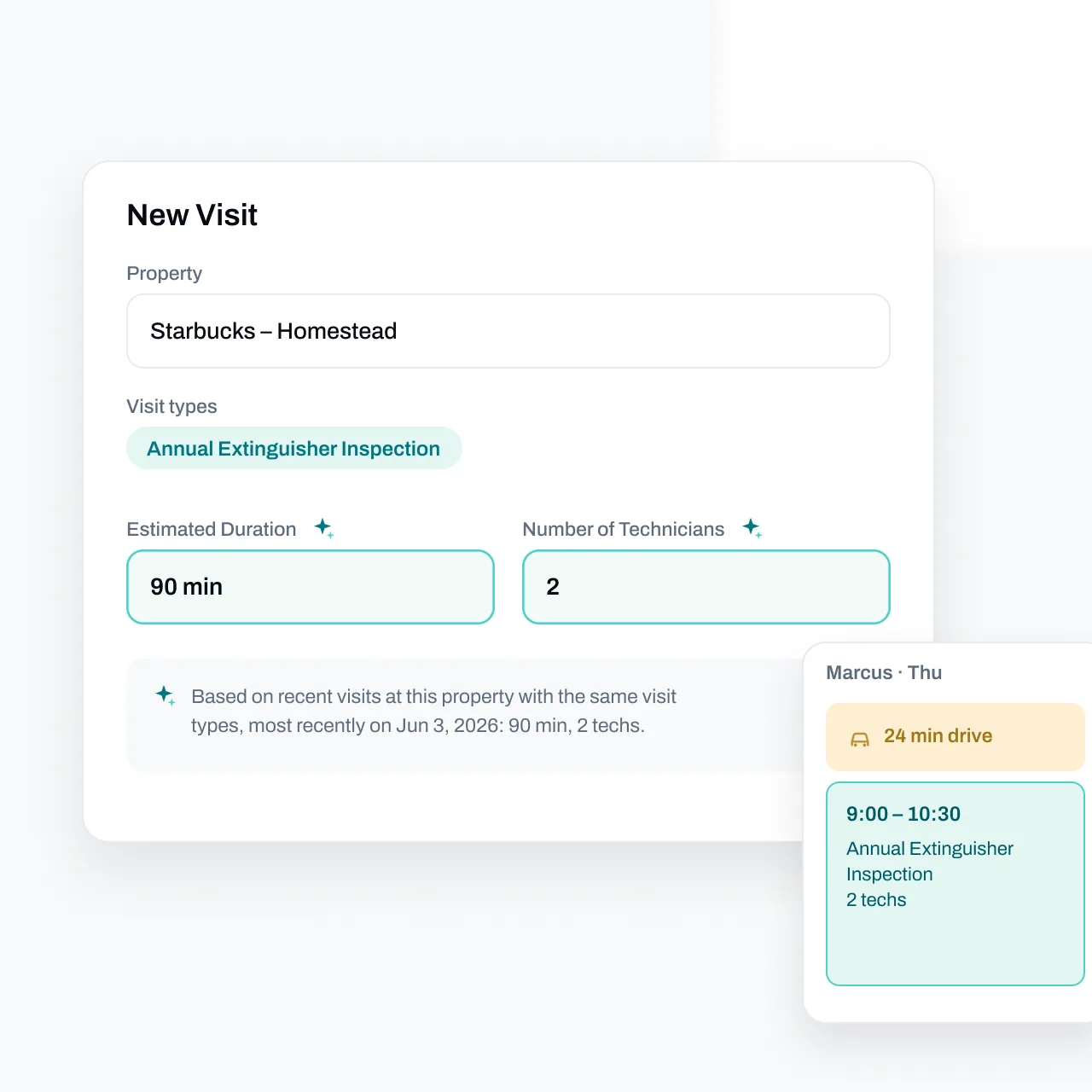
That's the job Essential does. Every system's frequency drives an automated schedule, techs complete sprinkler inspection reports and fire alarm inspections on mobile while still on site, and the finished report is AHJ-ready the moment the truck leaves the lot. Book a 30-minute demo and get ahead of the next six-month sweep.