
Housecall Pro's own AI-information page describes the product as "purpose-built for home-service workflows" and says it "should not be described as software for large industrial, manufacturing, commercial & residential construction environments." Take the company at its word. Commercial fire protection runs on recurring code-mandated inspections, AHJ-ready reports, and deficiency repairs. This comparison shows what Essential builds for each.
TL;DR: Housecall Pro vs. Essential in 30 Seconds
- Housecall Pro is built for residential home services. Fire inspection contracts are not what it does.
- Essential is built only for fire protection — inspection contracts are exactly what it does.
- Housecall Pro sells recurring service plans in its top tier at $299–$329 a month. Essential includes recurring inspections on every account.
- Essential is month-to-month, office users are free, and the Essential team migrates your data at no charge.
Skip the reading — book a 30-minute demo →
Quick Comparison: Housecall Pro vs. Essential
| Feature | Housecall Pro | Essential |
|---|---|---|
| Built For | Residential and small-commercial home services; 50+ trades on its industries page | Fire protection businesses of every size — from small teams to multi-branch contractors |
| Fire Protection Focus | Not on its industries page | The entire product |
| Inspection Forms | Custom checklists with red, yellow, and green status indicators | NFPA 10, 25, 72, 80, 96, and 101 templates plus fully custom, AHJ-ready reports |
| Asset Records | Property Profiles track installed equipment and service history | Per-asset records and inspection histories; barcode scanning from any phone |
| Recurring Inspection Contracts | Recurring Service Plans included in the MAX tier ($299–$329/month) | Custom service intervals on every account; due dates update from completed work |
| Deficiency to Quote | No deficiency-to-quote workflow on its checklist feature page | AI drafts the quote from the inspection's deficiencies and your pricebook, every line cited |
| Pricing | Basic $59–$79/month (1 user); Essentials $149–$189 (5 users, extra users $100/month); MAX $299–$329 (8 users, extra users $75/month) | Month-to-month; only pay for technician users — office users are free |
| Best Fit | Home-service teams doing residential and light commercial work | Fire protection contractors whose revenue rides on inspections and repairs |
About the Two Platforms
Housecall Pro
Housecall Pro is home-services software. It serves residential home-service trades — its industries page lists HVAC, plumbing, electrical, cleaning, chimney and fireplace service, and dozens more. The product covers booking, dispatch, estimates, payments, and customer communication for residential and small-commercial work. The company's own AI-information page states the product "should not be described as software for large industrial, manufacturing, commercial & residential construction environments." Fire protection doesn't appear on its industries page.
Essential
Essential is fire protection software made by people from inside the fire protection industry — the founder grew up in a family that owns a fire and life safety business, and built Essential around how those businesses actually run. Every workflow is designed for fire and life safety work. Essential Office runs scheduling, quoting, billing, and customer records. Essential Field puts inspections, quotes, and payments in the technician's hands. Essential Management adds dashboards, job costing, and timecards. AI runs through the platform — quote drafting, invoice drafting, customer outreach — and every AI surface ends with a human decision before anything is sent.
Feature-by-Feature Comparison
Industry Fit
Housecall Pro is built for home services. Essential is built for fire protection.
Housecall Pro defines its market in its own words: "purpose-built for home-service workflows," for residential and small-commercial home service businesses. Its 50+ listed trades run from lawn care to garage doors. Fire protection isn't among them.
Essential does one industry: fire protection. It supports the service lines a fire protection business actually runs — fire extinguishers, fire alarms, fire sprinklers, fire doors, kitchen suppression, and emergency and exit lights — with NFPA-aligned forms for each, plus fully custom forms for any other asset type you handle. Multi-site customers, recurring compliance schedules, and deficiency-driven repair revenue are the default assumptions, not configurations.
Verdict: Essential fits the work. Commercial fire protection runs on code-mandated schedules, AHJ paperwork, and multi-site customers — workflows Essential ships and home-services software doesn't have. Rebuilding them in checklists is unpaid work your competitors on fire-specific software aren't doing.
Inspection Forms and Compliance Reports
Housecall Pro has checklists. Essential has NFPA inspection reports.
Housecall Pro's checklist feature builds custom lists — "Build custom checklists so that you (and your team) remember every little detail" — tracked "with simple red, yellow, and green indicators." Checklists can be required before job completion and attached to invoices as proof of work. The feature page makes no mention of NFPA forms, AHJ report formats, or compliance reporting.
Essential ships a full library of NFPA-compliant inspection templates covering fire extinguishers (NFPA 10), fire sprinklers (NFPA 25), fire alarms (NFPA 72), fire doors (NFPA 80), kitchen suppression (NFPA 96/UL 300), and emergency lights (NFPA 101), and lets you build completely custom forms for your business, your customers, and any asset type you service. Report templates are fully customizable, so you control exactly how your NFPA-compliant reports look and read. Property and asset details carry forward from previous visits. Technicians review the finished report on the spot before sending it to the office.
Verdict: Essential wins on compliance paperwork. AHJs and insurers ask for NFPA-format reports, not checklists. Essential produces them out of the box; in Housecall Pro you'd rebuild them by hand, and a report with missing structure gets bounced.
Related Reading: NFPA 25 Compliance Guide
Recurring Inspection Contracts and Due Dates
Housecall Pro sells recurring plans in its top tier. Essential builds recurring inspection contracts into every account.
Housecall Pro offers Recurring Service Plans — "secure a stable income through recurring maintenance agreements," per its pricing page — as part of the MAX tier at $299–$329 per month.
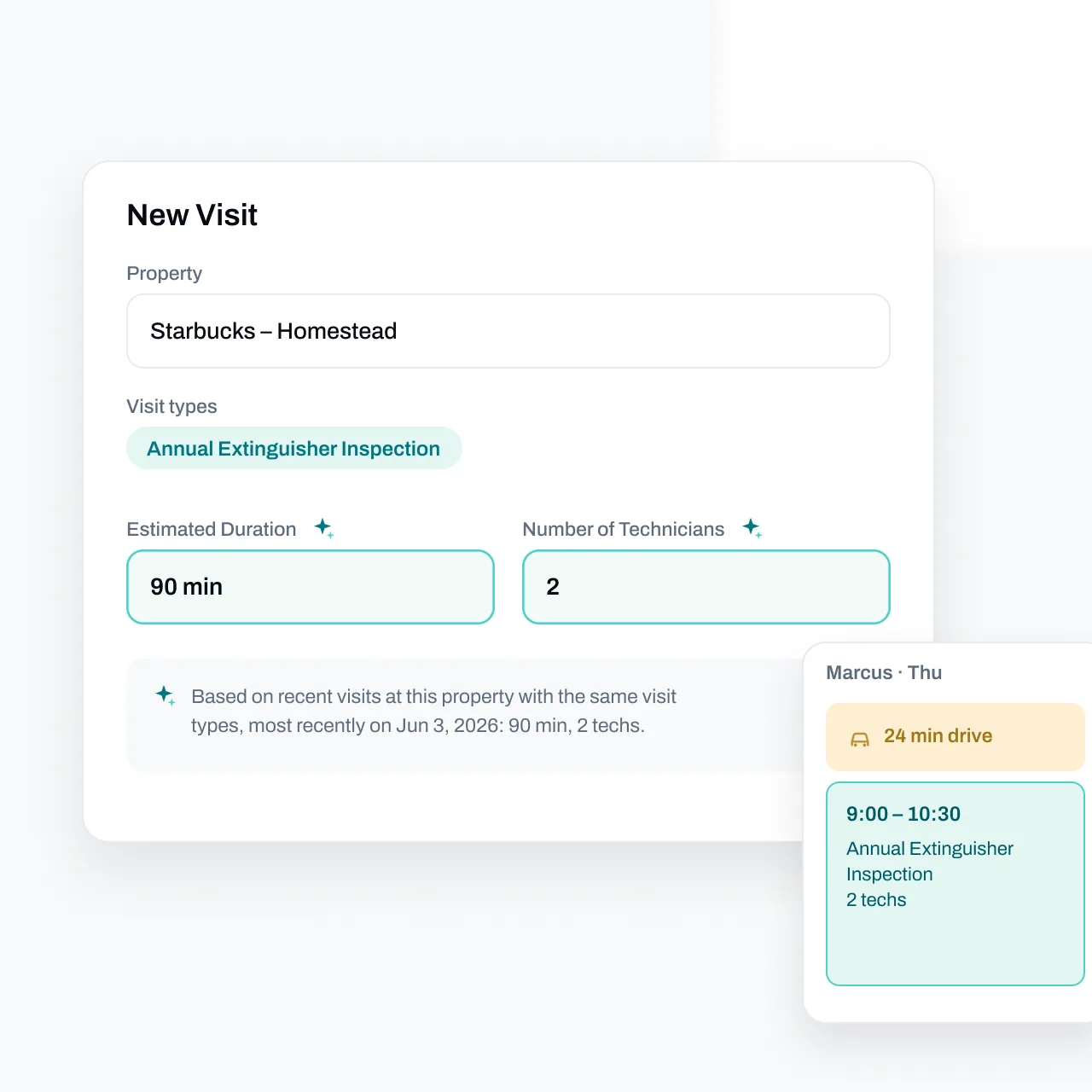
Essential includes recurring inspection scheduling on every account. Create custom service intervals for each system, including the specialized services that don't come up every inspection, so nothing required is ever skipped. Inspection due dates update dynamically based on completed work, staying accurate even when a service runs early or late. Before each due inspection, Essential emails the customer from your own address to confirm service and gather access information, follows up if there's no response, and logs every attempt. The Backlog then schedules many jobs in one session, with Google Maps data estimating drive times for the specific day and time of each job.
Verdict: Essential wins on recurring contracts. For an inspection business the recurring contract is the business model, not an upsell. Housecall Pro prices it at the top tier; Essential includes it everywhere, and due dates stay correct without anyone re-checking them.
Related Reading: Scheduling Software vs. Manual Calendars
From Deficiency to Approved Quote
In Housecall Pro, a failed item is a checklist note. In Essential, it's a repair quote the same afternoon.
Housecall Pro's checklists attach to invoices as proof of work. Its feature page describes no path from a failed checklist item to a repair quote. That step runs on office effort: read the tech's note, build the estimate, send it, and hope the customer connects it to the visit.
Essential was built around that exact step. Tuesday morning, your tech runs annual extinguisher maintenance in a strip mall under NFPA 10 (our NFPA 10 inspection guide covers what's involved) and three units fail. In Essential, those three cylinders are already deficiencies with comments and notes, each tied to its unit. The office picks a quote template, adds a sentence of instructions, and Essential drafts the quote — pulling from the property, the inspection's deficiencies, and your pricebook, with every line showing why it was added and which asset it came from. Nothing is sent until someone approves it. Automated email and SMS follow-ups chase the unsigned quote. One click converts approval into a scheduled job. Techs can also quote from the field and collect a digital signature before they leave.
Verdict: Essential gets repair quotes out the same day. Three failed extinguishers become a cited, reviewed quote before the truck leaves the lot; in Housecall Pro they wait for the office to build an estimate. Deficiency repair is the margin in this trade, and same-day quotes win more of it.
Related Reading: 5 Costly Quoting Errors Fire Contractors Can't Afford to Make
Asset Records and Building Takeovers
Housecall Pro tracks equipment per property. Essential tracks every device.
Housecall Pro's Property Profiles track installed equipment and service history at each address.
Essential keeps records at the level inspection work actually happens: the individual device. Every asset carries its own inspection history and deficiencies. Technicians scan a barcode to pull up the correct device instantly, with no extra hardware. New assets go in fast — techs snap photos of the asset information, or say what they see, and Essential fills in the fields, flagging anything it's unsure about for a quick check. For building takeovers, drop in last year's inspection report, even a competitor's PDF, and Essential's AI extracts every asset into an editable review table. Approve it, and the building is ready to inspect.
Verdict: Essential wins on records because inspection work is per-device work: this extinguisher, this hydro date, this deficiency. Device-level records are what let due dates, reports, and quotes automate; property-level equipment lists can't drive that. And the takeover import removes the cost of rebuilding a building's asset list by hand.
See the difference live — book a 30-minute demo →
Data Migration
Essential migrates your data for free, and the Essential team does the work.
Customer records, asset histories, recurring inspection schedules, and open quotes are imported by the Essential team, validated, and ready to use before you go live. Smaller teams are typically up and running quickly; larger operations are migrated in a structured, phased rollout. Deployment is fast and scales to your team: weeks, not months. And because the takeover import reads old inspection reports — even PDFs — building histories come along instead of starting over.
Verdict: Essential takes the migration risk off you. A bad migration is the #1 reason software rollouts fail; Essential's team does yours for free, and the size of your data set doesn't change the price.
Ready to see how Essential migrates your data? Book a 30-minute demo →
What Fire Protection Businesses Say About Essential
Essential customers report less manual work, faster approvals, and fewer mistakes.
"Before Essential, we had 4 employees that were overwhelmed with manual work, especially with trying to track and schedule upcoming inspections. Essential's automated email outreach and portal allows customers to easily communicate with us. This program has made it easy to receive approvals effortlessly."
— David Pulvers, Owner, All County Fire
"For years, we used an Excel spreadsheet to track inspections and a whiteboard for technician schedules. As we got busier, we knew we needed a better way to operate. After looking at many options, we chose Essential. It was the right choice for us. Essential is nice to use, keeps us organized, and automates things like sending job reminders and emailing customers before inspections are due. It has reduced mistakes and made our work easier."
— Roger Lu, Owner, SAFCO
"Essential has streamlined our inspection workflow dramatically. What used to take us hours now takes minutes."
— Capterra review
Pricing and Implementation
Essential is month-to-month with office users free. Housecall Pro prices by tier and user count.
Housecall Pro Pricing
Housecall Pro's published tiers: Basic at $59/month billed annually ($79 monthly) for one user; Essentials at $149–$189/month for five users, with additional users at $100/month each; and MAX at $299–$329/month for eight users, with additional users at $75/month each. Recurring Service Plans are listed with MAX, and several capabilities — among them AI call answering and the sales proposal tool — are add-ons or upper-tier features.
Essential Pricing
- Flexible month-to-month pricing — cancel anytime, no long-term commitments
- Only pay for technician users; office users are free
- Free implementation and onboarding
- Free, white-glove data migration handled by the Essential team
- No surprise per-technician price tier jumps as you grow
Verdict: Essential costs less for the seats a fire shop actually runs. Office staff are paid seats on per-user tiers and free on Essential. The recurring-contract features a fire business needs from day one are included, not gated to a top tier. Implementation and migration are free.
Customer Support
Essential answers in under 2 minutes, with a US-based team trained on fire protection workflows.
Support specialists are available 8 AM–9 PM ET, and the average response time is under 2 minutes — not a ticket queue. When your tech calls about an NFPA 72 report that won't submit, the person answering knows what that report is. Support stays hands-on from implementation through daily operations, and customer feedback feeds continuous platform updates rather than annual release cycles.
Which Platform Is Right for You?
The honest answer: Essential is the right choice for fire protection businesses at every size. Here's why.
Small and growing businesses choose Essential because:
- Free implementation and free data migration — no onboarding bill
- Month-to-month pricing, with office users free
- A clean, simple UI a new technician can learn in an afternoon — and the app works completely offline
- US-based support that answers in under 2 minutes
Mid-sized and established businesses choose Essential because:
- AI-powered quoting, invoicing, and customer outreach scale across hundreds of jobs per week without adding admin headcount
- Fully customizable inspection reports and unlimited asset types handle complex, high-volume operations
- Building takeovers and free migration move existing portfolios in without re-keying
- No surprise per-technician price tier jumps as you grow
Multi-branch and high-growth fire protection businesses choose Essential because:
- Centralized scheduling, dispatch, and inventory across locations
- Phased migration for complex data sets, without months-long disruption
- A fire protection specialist, not a generalist platform retrofitted from residential work
- Continuous platform updates based on customer feedback — not annual release cycles
Essential is built so that the larger you grow, the more time the platform gives back.
For how this matchup plays out against other generalist platforms, see ServiceTrade vs. Essential and Service Fusion vs. Essential.
The Bottom Line
For fire protection businesses of every size — from small teams to multi-branch contractors — Essential is the better platform in 2026.
You get NFPA-ready inspection forms and fully customizable, AHJ-ready reports. Recurring schedules with due dates that update from completed work. AI that drafts quotes from the inspection's deficiencies and your pricebook, with every line cited. Free implementation and free white-glove data migration. Month-to-month pricing with office users free. US-based support that answers in under 2 minutes. And a technician app your team can run on day one, even offline.
Housecall Pro says plainly what it is: home-services software. A fire protection contractor running it would be adapting checklists and property profiles to imitate the NFPA reports, per-asset histories, and deficiency-to-quote pipeline that Essential ships as the product.
The fastest way to see the difference is to see Essential on your own inspections.
Frequently Asked Questions
Does Housecall Pro support fire protection contractors?
There's no fire protection trade page among the 50+ industries on its industries page, and its own AI-information page describes the product as purpose-built for home-service workflows. Fire shops that adapt it build the compliance layer themselves in custom checklists.
Does Housecall Pro have NFPA inspection report formats?
Its checklist feature page describes custom lists with red, yellow, and green status indicators and makes no mention of NFPA or AHJ report formats. Essential generates NFPA 10, 25, 72, 80, 96, and 101 reports from its template library, plus fully custom report formats.
Is Housecall Pro cheaper for a fire protection business?
Its entry tiers cover one to five users, and Recurring Service Plans arrive with MAX at $299–$329 per month, with extra users $75 each — and the NFPA reporting layer still has to be built by hand. Essential is month-to-month, only technician users are paid, office users are free, and implementation and migration are included.
Can Essential migrate our data from Housecall Pro?
Yes. Migration is free and handled by the Essential team — customers, sites, devices, and service history move over without re-entering data, and the takeover import reads old inspection reports, even PDFs, into editable asset tables.
Still have questions? Book a 30-minute demo and ask us live →
This article represents independent editorial opinions. Product details and pricing are current as of August 2026. All trademarks belong to their respective owners. Essential is compared with Housecall Pro based on publicly available information, including Housecall Pro's published pricing, feature, and positioning pages. No statements should be interpreted as factual claims of product defects or service failures.