

You just picked up a campus account with 200+ risers spread across 14 buildings. Wet systems, dry systems, a couple of fire pumps, standpipes in the high-rises, and a handful of backflow preventers. Your first thought isn't "great, more revenue." It's "how do I track all of this without something falling through the cracks?"
That's the real challenge of NFPA 25 compliance in 2026. It's not that the inspection, testing, and maintenance requirements are a mystery. Most experienced contractors know what needs to happen. The hard part is making sure it actually happens on time, across every system, at every frequency, with documentation your AHJ will accept. And with the 2026 edition of NFPA 25 now published, there are new requirements you need to know about.
What changed in the NFPA 25 2026 edition
The 2026 edition took effect September 9, 2025, replacing the 2023 edition as the current standard. Most jurisdictions haven't adopted it yet (many are still on the 2020 or 2023 edition), but the changes will start showing up in your AHJ conversations soon enough.
The biggest change is a new rule for dwelling-unit sprinklers. Section 5.3.1.1.1.7 now requires that sprinklers installed 50 or more years ago in dwelling units (hotels, dorms, apartments, assisted living facilities) must either be replaced with fast-response heads or pass a thermal sensitivity test. If you service aging residential occupancies, this creates a whole new category of work. Buildings that were previously compliant may now need head replacements or lab testing, and most building owners have no idea this is coming.
The 2026 edition also added requirements for inspecting systems after freeze events, updated fire pump circulation and pressure relief valve ITM in Chapter 13, and clarified that fire-affected sprinklers must be replaced as determined by the AHJ.
And if your jurisdiction just adopted the 2023 edition, don't forget those changes either: fast-response sprinkler testing got extended from 20 to 25 years, dry sprinkler testing went from 15 to 20 years, and the painted-head rule was softened. Inspectors now have discretion when paint isn't detrimental to sprinkler performance, rather than requiring automatic replacement for any amount of overspray.
The NFPA 25 frequency matrix (and why it breaks people)
NFPA 25 compliance is not one schedule. It's dozens of overlapping schedules that vary by system type, component, and sometimes even by whether something is electronically supervised.
Take that campus account. Your wet pipe systems need quarterly gauge checks, annual head inspections, annual main drain tests, and 5-year internal pipe assessments. But the dry systems on the top floors? Those need monthly air pressure checks (quarterly if supervised), annual trip tests, 3-year full-flow trip tests, 3-year air leakage tests, plus everything the wet systems need. The fire pumps require weekly no-flow tests (30 minutes for diesel, 10 for electric), annual full-flow performance testing, and annual maintenance on oil, filters, batteries, and connections.
Then add in your standpipe flow tests every 5 years, FDC hydrostatic tests every 5 years, gauge replacement or calibration every 5 years, and control valve checks that range from daily (unsecured) to weekly (locked/sealed) to monthly (electronically supervised).
For a single building with mixed system types, you could easily have inspection obligations at daily, weekly, monthly, quarterly, semiannual, annual, 3-year, 5-year, 10-year, and now 50-year intervals. Multiply that across 14 buildings and 200+ risers, and you start to understand why so many contractors still have that "what did I miss?" feeling on Sunday nights.
The frequencies that trip people up
The quarterly and annual stuff rarely gets missed because it's routine. It's the less frequent items that create problems.
5-year internal pipe assessments require opening flushing connections at system high points to check for obstructions and corrosion. These access points are often hard to reach, and the work requires a coordinated system shutdown, impairment procedures, fire alarm notification, and sometimes a fire watch. It's not a quick job, and it's easy to let it slide.
Gauge replacement or calibration every 5 years is probably the single most commonly cited deficiency in the industry. Every riser has gauges. Every fire pump has gauges. Every backflow preventer has gauges. And every one of them needs to be replaced or calibrated against a reference gauge on a 5-year cycle. The date should be stamped right on the gauge face, so there's no hiding from an inspector who's paying attention.
Dry system 3-year tests (full-flow trip test and air leakage test) are another common gap. Three years is long enough to forget, short enough that AHJs expect to see the documentation.
Sprinkler head lab testing at the 50-year mark (standard response), 25-year mark (fast response), or 20-year mark (dry type and ESFR/CMSA) catches many contractors off guard. Knowing the installation date matters, and for older buildings that have changed hands multiple times, that information can be hard to track down.
The deficiencies your technicians need to watch for
Some deficiencies come up again and again across every jurisdiction. If you're training technicians or doing quality reviews on completed reports, these are the ones to hammer home.
Painted sprinkler heads remain near the top of every AHJ's findings list. Building maintenance crews repaint rooms and hit the heads with overspray. The 2023 edition gave inspectors some discretion here (paint must be "detrimental to performance" rather than simply present), but a visibly painted head is still going to get flagged. Storage stacked within 18 inches of deflectors is another constant. Tenants and facility staff move things around, and what was clear last quarter may not be clear today.
Missing or illegible hydraulic nameplates, missing system signage, and inadequate spare sprinkler inventories are documentation issues that carry more weight than most contractors realize. NFPA 25 can require up to 18 pieces of information on signage for a single riser. And the spare head counts are specific: 6 spares for systems with fewer than 300 heads, 12 for 300 to 999 heads, and 24 for 1,000 heads or more. Plus the wrench.
But the deficiency with the highest stakes isn't a broken head or a missing sign. It's a closed control valve. NFPA's own data shows that closed valves account for the majority of sprinkler system failures during actual fires. That's not a mechanical failure. That's a human failure, and it's the whole reason NFPA 25 requires weekly valve position checks on locked or sealed valves. When your technicians are on site, valve position should be the first thing they verify.
Deficiency classification matters
What most contractors miss is that NFPA 25 classifies deficiencies into three tiers, and the classification drives the required response.
Noncritical deficiencies (missing signs, low spare count) need correction within a reasonable timeframe. Critical deficiencies (painted heads, significant corrosion) need correction as soon as possible. And impairments (closed valves, inoperative fire pumps) trigger Chapter 15 impairment procedures, including AHJ notification and potentially fire watch coverage.
The tricky part: the same condition can be classified differently depending on context. A painted head in a storage closet might be critical. That same painted head protecting a server room full of irreplaceable data? Your AHJ might call that an impairment. Context matters, and your reports should reflect that.
Why AHJ enforcement is tightening (and going digital)
If you've been in the business long enough, you remember when AHJ enforcement was inconsistent at best. Some jurisdictions barely checked. Those days are ending.
The biggest driver is digital reporting platforms. BRYCER's "The Compliance Engine" is now used by over 1,400 AHJs across at least 37 states. Contractors submit reports digitally, and the system automatically flags overdue properties and unresolved deficiencies. There's no more "lost in the filing cabinet" excuse. If your inspection is overdue or your deficiency corrections aren't documented, the AHJ knows about it in real time.
For contractors, this cuts both ways. On one hand, it creates more accountability for building owners (which is a good thing). On the other hand, it means your documentation needs to be airtight. Incomplete reports, missing signatures, or vague deficiency descriptions that would have slipped by five years ago will now get kicked back.
Insurance companies have become a parallel enforcement mechanism too. Inspections overdue by more than a year can trigger premium surcharges. Go past three years, and the building may lose its sprinkler credit entirely, getting rated as unsprinklered. In at least one documented case, an insurer denied a six-figure fire damage claim citing NFPA 25 non-compliance, and a judge upheld the denial.
The practical takeaway for contractors: your reports are legal documents now, whether you think of them that way or not. They need to be thorough, accurate, and delivered on time.
Managing NFPA 25 compliance across a large portfolio
Let's go back to that 200-riser campus account. You've got wet systems, dry systems, fire pumps, standpipes, FDCs, and hundreds of control valves. Every component has its own inspection frequency. How do you actually keep track of all of it?
The answer used to be spreadsheets and a really good office manager. And for a small shop doing 10 or 15 accounts, that can work (barely). But once you're past 50 accounts, or you're managing multi-building campuses, the spreadsheet approach starts generating mistakes. Due dates get missed. 5-year items slip to year six. A technician does a quarterly but forgets to log a deficiency. The office spends hours manually calculating next-due dates every time a report comes in. Purpose-built fire protection software exists specifically to solve this problem.
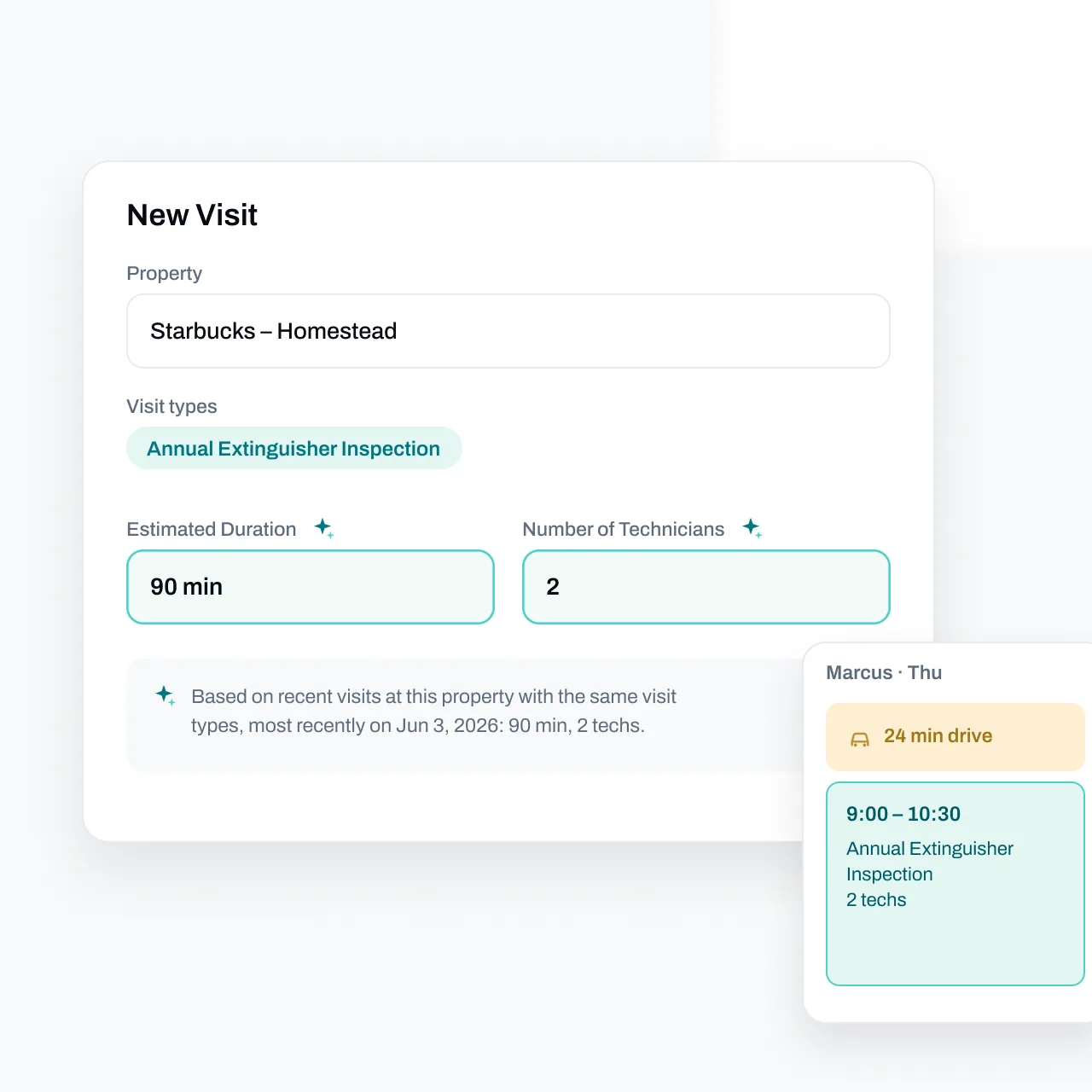
Fire protection software built for this specific problem can automate due date tracking so nothing slips through the cracks. Platforms like Essential include NFPA 25 inspection templates and automatically recalculate next-due dates based on completed work, which takes the manual math off your office team's plate. When you're juggling quarterly, annual, 3-year, and 5-year frequencies across hundreds of systems, that kind of automation is the difference between staying compliant and hoping you're compliant.
Whatever system you use (software, spreadsheets, or a really organized filing cabinet), the key principles are the same. Track every system component and its frequency separately. Don't lump "annual sprinkler inspection" and "annual main drain test" into one line item, because they can fall out of sync. Document baseline readings (especially main drain pressures) so you have comparison data for future tests. And build your scheduling around the longest-cycle items first, then layer in the shorter frequencies.
Talking to building owners about compliance
One of the most frustrating parts of NFPA 25 compliance is that the standard puts responsibility squarely on the building owner, but most building owners don't know that. They think they hire a sprinkler contractor and the compliance problem goes away.
You can turn this into a business advantage. Proactive customer communication about upcoming obligations (especially the expensive ones like 5-year internal assessments or head replacement testing) builds trust and sets expectations. When you find deficiencies, don't just list them on a report. Explain what they mean, why they matter, and what happens if they're not corrected. Generating quotes directly from deficiency findings makes it easier for owners to approve the work quickly. A building owner who understands that a closed valve could void their insurance claim is far more likely to approve the repair than one who sees a cryptic code reference on a form.
The new 50-year dwelling-unit sprinkler rule is a perfect example. If you service older hotels, apartment buildings, or assisted living facilities, start identifying buildings that may be approaching that threshold now. A conversation today about planned replacement over the next few years is much easier than a surprise compliance notice from the AHJ.
If you're tired of tracking NFPA 25 due dates in spreadsheets and hoping nothing falls through the cracks, book a quick demo with the Essential team to see how automated inspection tracking works in practice. There's no commitment, and the implementation is free.
Software built for NFPA 25 inspections
Essential is all-in-one fire sprinkler inspection software — NFPA 25 templates, automated scheduling, deficiency tracking, and inspection reports in one platform.
NFPA 25 scope also covers fire pump testing software, fire hydrant testing software, and backflow testing software. If you'd rather start with the field procedures, our guides to the fire pump churn test and backflow testing requirements cover what the tech does on site and what the record has to show.