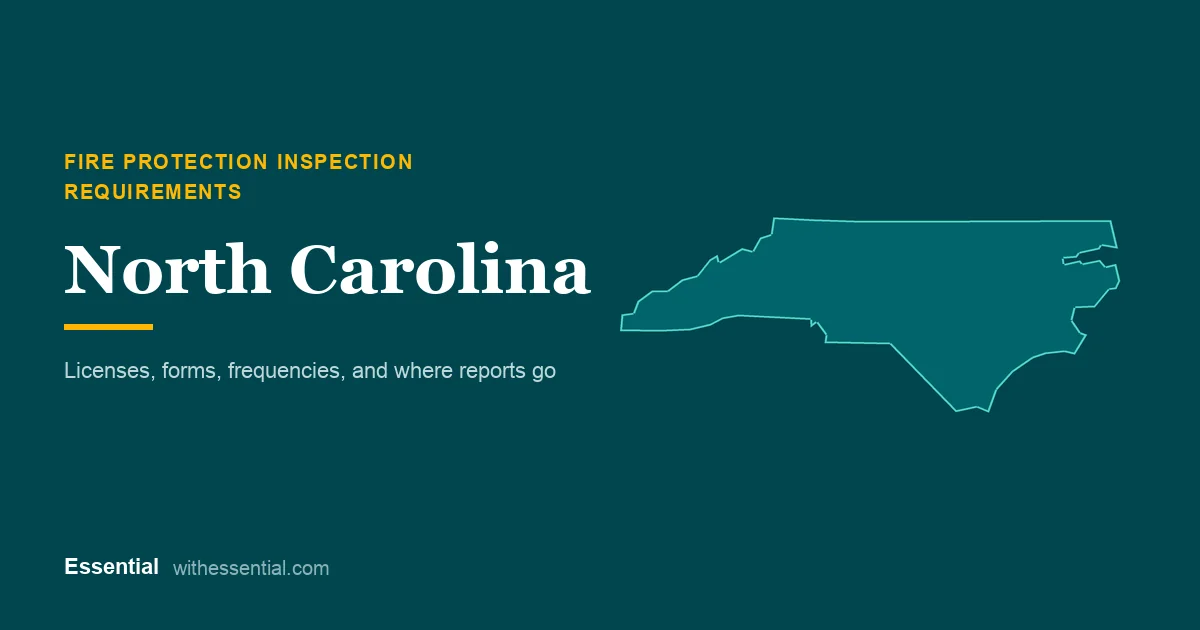

North Carolina contractors are working through a code transition that keeps stretching. The 2018 North Carolina State Building Code, including the Fire Code, is still the edition in effect, as it has been since January 1, 2019, built on the 2015 International Fire Code. A 2024 edition has been adopted, but the General Assembly has delayed its effective date, most recently tying it to conditions the State Fire Marshal must certify. Until that flips, cite 2018 sections in your reports and watch OSFM's announcements before you update templates.
Who regulates fire protection work in North Carolina
The Office of the State Fire Marshal (OSFM) manages the state's code program, publishes formal interpretations, and supports the local fire officials who do the enforcing. Inspections and report collection happen at the city and county fire marshal level, and licensing sits with independent occupational boards rather than OSFM itself. That three-way split, OSFM for code, local AHJs for enforcement, boards for licenses, is the map to keep in your head.
Licensing: NICET runs deep here
Sprinkler licensing belongs to the State Board of Examiners of Plumbing, Heating and Fire Sprinkler Contractors, created under G.S. Chapter 87, Article 2. The board's qualification bar is concrete: the Fire Sprinkler Installation Contractor exam requires current NICET Level III certification in automatic sprinkler system layout, and the Fire Sprinkler Inspection Technician exam requires two years, 4,000 hours, of hands-on inspection and testing experience. There's also a residential installation pathway for licensed plumbing contractors who complete a board-approved course. If you're buying or expanding a sprinkler shop in North Carolina, the NICET roster is the asset to check first.
Fire alarm work requires the SP-FA special restricted electrical license from the State Board of Examiners of Electrical Contractors. One quirk worth knowing: fire alarm installation and service is exempt from the Chapter 74D security systems license, so a fire-alarm-only company doesn't need the Alarm Systems Licensing Board credential. Add burglar or access control work, though, and 74D licensing comes back into play.
Portable extinguishers are the opposite story: no state contractor license exists for that trade. What fills the gap is certification. In a 2020 formal interpretation, OSFM concluded that annual extinguisher inspection and tagging is maintenance under NFPA 10, "must be performed by certified personnel," and that the 2018 NC Fire Code's Section 906.2 requires maintenance in accordance with NFPA 10 (2013 edition). Fire marshals lean on that letter; techs without a current certificate get shut down.
Report forms and required records
North Carolina doesn't issue statewide ITM report forms, and there's no numbered state filing to attach. Reports follow the NFPA formats, tags follow NFPA 10 and NFPA 25 conventions, and the enforceable requirement is that records exist and reach the fire code official when asked. Local fire marshals decide the how. Some accept paper or email. A growing set of cities has moved to mandatory electronic submission, which is where the real deadlines live.
Inspection frequencies, straight from the enforced code
Chapter 9 of the 2018 Fire Code hands ITM to the NFPA standards: NFPA 25 for water-based systems, NFPA 72 for alarms, NFPA 10 for extinguishers. For a working picture of what AHJs collect, Gastonia's fire marshal publishes its list: fire alarm annually, sprinkler systems annually plus five-year reports, fire pumps annually, kitchen hood suppression twice a year, private hydrants annually with five-year reports, and fire door testing annually. If fire doors aren't on your service menu yet, that last line is a revenue item most competitors still skip; Essential's fire door inspection software was built for exactly that add-on.
Where reports go: TCE is spreading city by city
Gastonia requires all compliant and non-compliant system reports to be submitted electronically through The Compliance Engine, a program it formalized with Brycer in November 2023. Where a city hasn't made that move, the local fire marshal's office sets the channel. A Charlotte-area company can serve one city on TCE and a neighboring town on emailed PDFs, and the fastest way to lose an account is a report that never arrived at either.
Staying compliant while the code shifts under you
Between the 2018-to-2024 transition, board licensing, and city-by-city submission rules, North Carolina punishes shops that run on memory. Essential replaces the memory: recurring inspections scheduled to each system's NFPA frequency, mobile forms for sprinkler and fire alarm work, deficiency tracking, and reports formatted for the AHJ on every job. In TCE cities like Gastonia, reports file straight to The Compliance Engine through Essential's integrations. Take a 30-minute demo and see what your five-year sprinkler report looks like when the paperwork finishes before the truck leaves the lot.