
Georgia moved its state minimum fire safety standards to the 2024 International Fire Code and the 2024 edition of NFPA 101, adopted in Rule 120-3-3-.04 of the Safety Fire Commissioner's regulations, a rule amended five times in 2025 alone, most recently effective December 28, 2025. That's a newer baseline than most states enforce, and it matters on the ground: a deficiency argument built on an older edition's language can lose in Georgia even when it would win next door. The same rule chapter renames the IFC the "Georgia State Minimum Fire Prevention Code" and modifies it clause by clause.
Who regulates fire protection work in Georgia
Fire safety here runs through the Office of the Commissioner of Insurance and Safety Fire (OCI), whose Safety Fire Division houses the state fire marshal function and the licensing programs. The Commissioner's rules apply statewide by their own force. Rule 120-3-3-.02 says they "shall not require adoption by a municipality or county," which means there's no patchwork question about whether a given county picked up the fire code. Local fire marshals enforce the standards on most buildings, while certain occupancies listed in O.C.G.A. 25-2-13, such as schools, hospitals, and high-rises, get state-level attention. When you're unsure who inspects a property, ask the local fire marshal's office first.
Licenses for sprinkler, alarm, and extinguisher companies
Water-based work is licensed by OCI. Fire protection sprinkler contractors hold a Certificate of Competency issued by the Commissioner, and local officials can't demand anything beyond that certificate as proof of competency. The enforcement details live in Chapter 120-3-19, the rules under the Georgia Fire Sprinkler Act. Pay attention to Rule 120-3-19-.12: NFPA 25 inspection, testing, and maintenance may only be performed by licensed fire protection system inspectors, certificate of competency holders, or qualifying representatives of the building owner. An unlicensed helper closing out an annual inspection is a violation, not a shortcut.
Extinguisher and suppression system companies are licensed under Chapter 120-3-23, which covers installing, inspecting, recharging, repairing, servicing, and testing portable fire extinguishers and fire suppression systems, kitchen hood systems included. The company license requires a certificate of liability insurance naming the Commissioner, with at least $1,000,000 in coverage, and the individuals doing the work hold state permits.
Fire alarm installation is the odd one out: it's a construction trade under the Secretary of State. Alarm companies need a low voltage contractor license, Class LV-A (alarm) or LV-U (unrestricted), from the Georgia State Board of Low Voltage Contractors. If your company self-performs sprinkler, alarm, and extinguisher work, you're maintaining credentials with two separate state agencies.
Tags, certificates, and the paper Georgia expects
Georgia is specific about tagging. For water-based systems, Chapter 120-3-19 applies the NFPA 25 tagging provisions and goes further for impairments: when a system or part of one is removed from service, the tag gets posted at each fire department connection, system control valve, fire alarm control unit, fire alarm annunciator, and fire command center. Inspection records and certificates stay available to the fire code official on request, so treat the on-site file as part of the job, not an afterthought.
There's no statewide inspection report form number to memorize. Report content comes from the NFPA standards, and individual fire marshals add their own submission requirements. When a local office asks for something unusual, get it in writing and build it into the recurring job.
How often systems get inspected
The frequencies come from the NFPA standards the state adopted in 120-3-3, including NFPA 10 in its 2022 edition. In practice: quarterly and annual inspections plus five-year internals for sprinkler systems under NFPA 25, annual testing for most alarm devices under NFPA 72, monthly checks and annual maintenance for extinguishers under NFPA 10, and kitchen system service on the semiannual cycle with NFPA 96 exhaust cleaning scaled to cooking volume. Where a local fire marshal enforces a tighter schedule, the tighter schedule governs.
Where inspection reports go
Smyrna's fire marshal requires service providers to submit compliant and non-compliant test reports electronically through The Compliance Engine, Brycer's third-party portal. Elsewhere, reports go to the local fire marshal by email or paper, and the customer keeps the file copy. A suppression company working Cobb County can hit a TCE town and an email-only town in the same afternoon, which is exactly how reports get missed and accounts go delinquent without anyone noticing.
Keeping Georgia accounts compliant without chasing paper
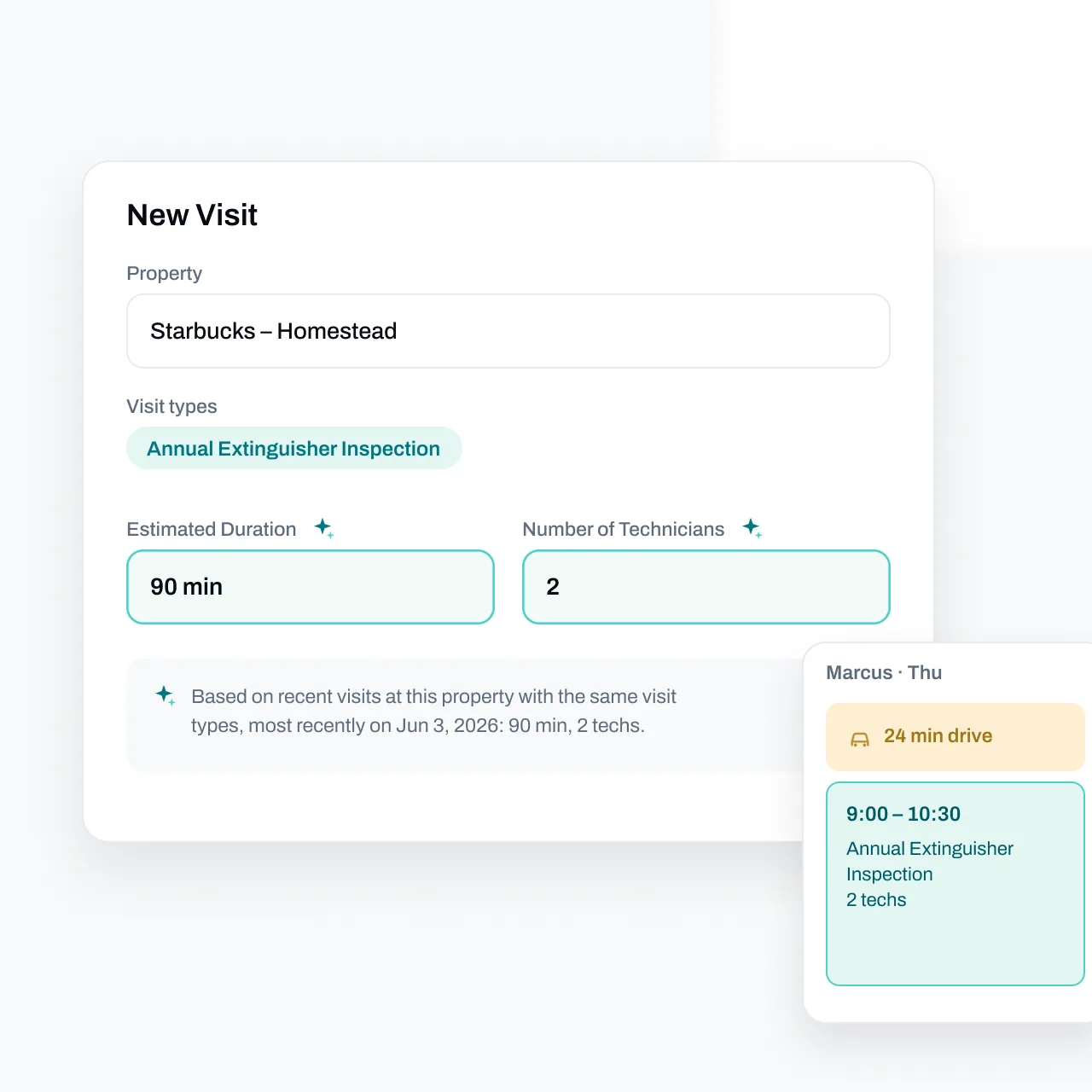
Between two licensing agencies, the 2024 code editions, and city-by-city submission rules, Georgia rewards contractors who run tight back offices. Essential does that work in the background: recurring inspections scheduled to the NFPA frequency, mobile checklists for sprinkler, extinguisher, and kitchen suppression work, and finished reports formatted the way fire marshals expect. In TCE jurisdictions like Smyrna, Essential submits straight to The Compliance Engine through its integrations, so the tech who tagged the riser doesn't owe the office a second data-entry shift. Grab a 30-minute demo and see a Georgia annual go from inspection to submitted report in one pass.