
Ask three Arizona fire departments which fire code they enforce and you can get three different answers. The State Fire Marshal adopts a State Fire Code by incorporating the International Fire Code by reference, Phoenix maintains its own amended code, and the fire districts serving unincorporated communities adopt theirs. For a contractor running routes across the Valley, the code question gets settled per address, not once.
Who regulates fire protection work in Arizona
The Office of the State Fire Marshal sits inside the Department of Forestry and Fire Management and operates under Title 37, Chapter 9, Article 4 of the Arizona Revised Statutes, handling code adoption, plan review, inspections, and fire investigation (DFFM State Fire Marshal). Administrative rule R4-36-201 incorporates the International Fire Code as the State Fire Code, and the edition question now has a firm answer: as of April 13, 2026, the State Fire Marshal operates on the 2024 IFC, with plan review run against IFC 2024 and its supporting NFPA standards (DFFM State Fire Marshal). References to the 2018 edition, including the Legislature's 2025 SB 1348 fact sheet, describe the code before that switch (SB 1348 fact sheet).
The ground also shifted in 2025: SB 1348 created phased permitting with defined review timelines for projects reviewed by the State Fire Marshal and allows cities and towns to approve construction permits in place of that office (SB 1348, 2025). Cities like Phoenix and Tucson, plus fire districts, adopt and enforce their own codes — your AHJ depends entirely on where the building sits.
Licensing: the Registrar of Contractors owns the trade side
Arizona has no fire-marshal-issued contractor license. Fire protection contracting runs through the Registrar of Contractors:
- C-16 / R-16 / CR-16 Fire Protection Systems — installation, alteration, and repair of systems using water, steam, gas, or chemicals, including restaurant hood protection, fire pumps, storage tanks, piping and valves, sprinkler heads and nozzles, and the low-voltage signaling and controls tied to those systems (ROC classification scopes). The CR-16 dual classification combines the commercial and residential scopes (A.A.C. R4-9-104).
- C-67 / R-67 / CR-67 Low Voltage Communication Systems — the classification family alarm-focused companies typically hold. Scope boundaries between -16 and -67 work matter on mixed jobs, so verify your classification covers the contract before bidding (ROC classifications).
For extinguisher and suppression technicians, Arizona's requirements flow from the adopted codes and their referenced standards rather than a separate state technician license. Cities can impose their own credential expectations, so ask the AHJ what it wants to see on a tech's card.
Required reports: Phoenix made it electronic
Arizona has no statewide ITM report form. The state's biggest AHJ, though, decided how it wants reports delivered. The Phoenix Fire Department partnered with Brycer effective December 1, 2019 under Ordinance G-46120: third-party inspection and test reports for fire protection systems go through The Compliance Engine. Once a report lands, fire inspection staff review it and follow up with the premises' responsible party on deficiencies.
Outside Phoenix, practice varies by city and fire district. Some track systems electronically, others still take PDFs or paper. Build the delivery method into each customer record and confirm it with the AHJ rather than assuming the Phoenix model applies metro-wide.
Inspection frequencies
Service intervals come from the NFPA standards the adopted codes reference:
- NFPA 25: quarterly and annual inspection and testing for water-based systems
- NFPA 72: annual fire alarm testing
- NFPA 10: monthly visual checks, annual extinguisher maintenance
- NFPA 96: six-month service cycles for commercial kitchen systems
Arizona's growth adds a wrinkle: new restaurants and warehouses come online constantly, and every acceptance test starts another recurring ITM clock the day the certificate of occupancy issues.
Where a route business feels this
Consider an extinguisher and hood company running 60 stops a month across Phoenix, Glendale, and two fire districts. The NFPA 10 and NFPA 96 work is identical everywhere. Delivery isn't: the Phoenix stops require Compliance Engine filings that a fire inspector will personally review, while the district stops might want emailed PDFs. A tech who fixes a hood but files nothing in Phoenix has, as far as that AHJ can see, never been there. The report is the proof of work.
Staying compliant in Arizona
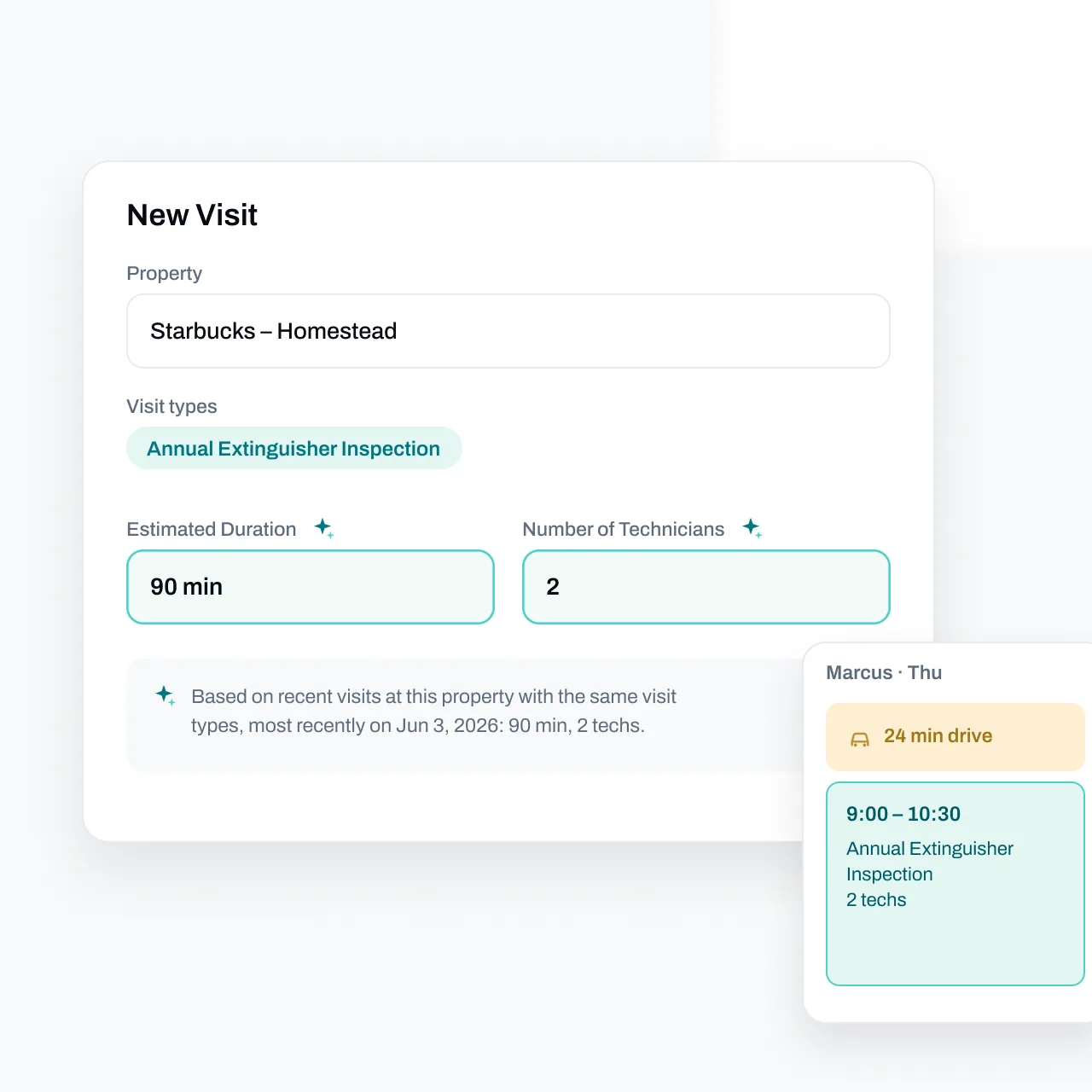
Essential keeps the per-address rules straight so your techs don't have to. Recurring schedules cover every NFPA 25, 72, 10, and 96 interval, mobile inspections capture the work on site, and reports come out formatted for the receiving AHJ. For Phoenix and other Compliance Engine jurisdictions, the TCE integration files reports automatically, and the same platform runs your fire alarm and kitchen suppression inspection workflows end to end. If proving the work is taking longer than doing it, book a 30-minute demo.