
Fire doors are the piece of the passive fire protection system that everyone walks through and nobody looks at. NFPA 80 looks at them once a year, in writing, and an increasing number of AHJs and accreditation surveyors are asking for the records. For fire protection contractors already doing alarm and sprinkler inspections in a building, that's a service line sitting in plain sight.
What NFPA 80 requires
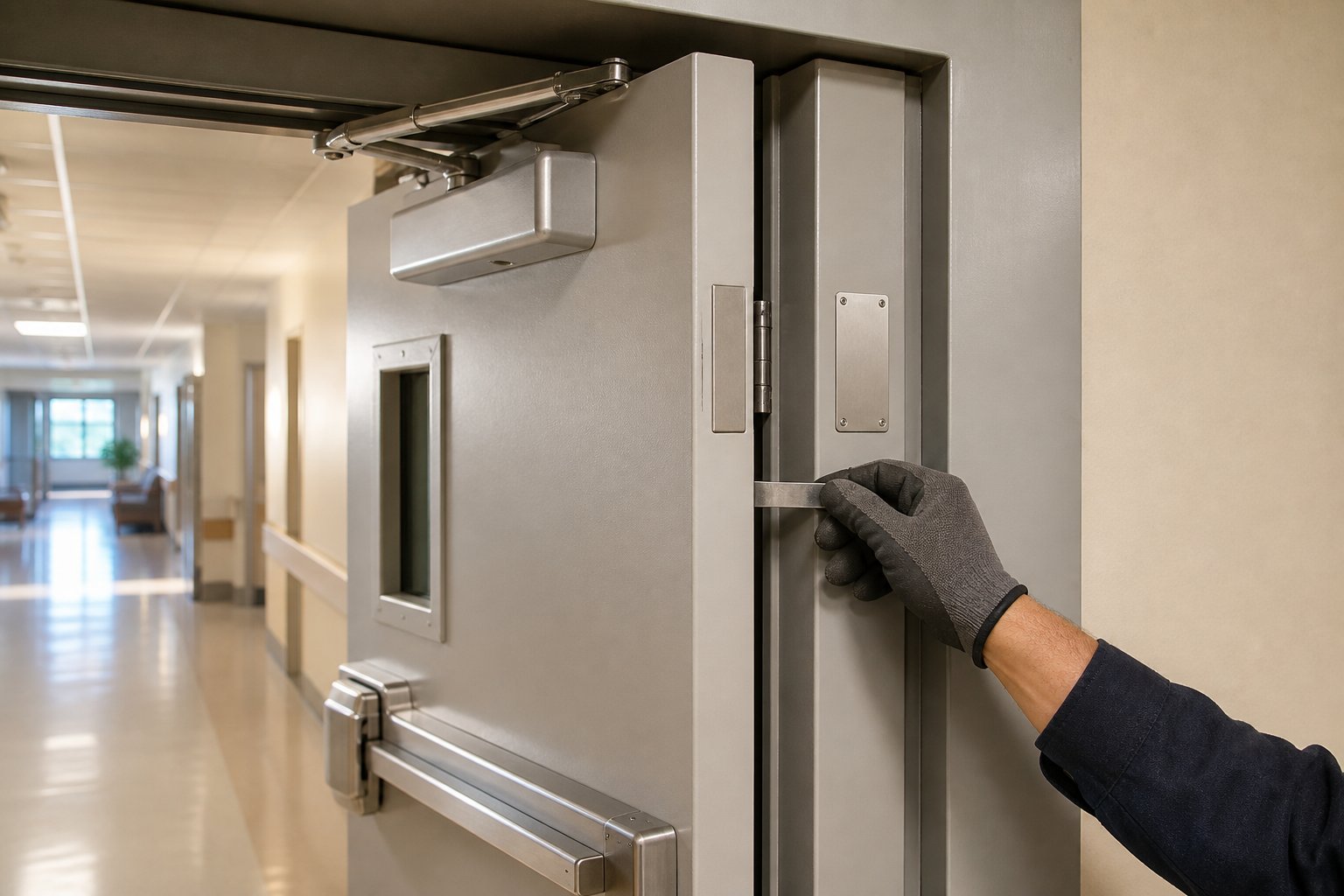
NFPA 80 requires fire door assemblies to be inspected and tested not less than annually, with the inspection documented in a written record the owner keeps for review by the AHJ. For swinging doors, section 5.2.4.2 of the 2022 and 2025 editions lists thirteen verification points, covering the full assembly rather than just the slab:
- Labels present, clearly visible, and legible
- No open holes or breaks in the door or frame
- Glazing, vision light frames, and glazing beads intact and securely fastened
- Door, frame, hinges, hardware, and threshold secured, aligned, and working, with no visible damage
- No missing or broken parts
- Door clearances within the limits the standard sets
- Self-closing device closes the door fully from the open position
- On pairs, the coordinator closes the inactive leaf before the active leaf
- Latching hardware operates and secures the door when it's closed
- No auxiliary hardware that interferes with or prohibits operation
- No field modifications that void the label
- Meeting-edge protection, gasketing, and edge seals, where required, intact and functioning
- Signage on the door meets the standard's size and attachment requirements
A fire door has to close and latch on its own to do its job. For most doors that means a self-closing device; automatic-closing doors on listed hold-opens that release on alarm are equally compliant. A door propped open with a wedge is neither, and it's the single most common finding in the field.
Two boundaries worth knowing before you build the template: the 13 points apply to swinging doors, and other assembly types, from rolling steel doors to shutters, carry their own criteria in the standard. Under 5.2.2, an AHJ can also approve a performance-based inspection program on a different interval. Work from the exact list in your copy of the standard; the points above are the shape of it, and the wording matters when an AHJ compares your report to the code.
Who's buying this inspection
Healthcare drives the demand. Hospitals and long-term care facilities answer to accreditation surveyors who treat fire door records the way an AHJ treats alarm reports, and a facilities director staring down a survey will pay for a clean, door-by-door report on short notice. Schools, hotels, and multi-family buildings follow behind as local enforcement catches up.
Picture the field work: a hospital annual, 240 doors, each one needing 13 points verified and recorded. A finding on door 118, a failed latch, needs a photo, a location, and a repair quote the facilities director can approve before the surveyor arrives. Done on a clipboard, that's two days of inspecting and another day of typing. Done in an app that steps through the 13 points per door, the report exists the moment the last door closes.
Adding doors to an inspection business
Fire door inspection needs trained eyes but no water, no panel, and no shutdown windows, which makes it the lowest-friction line a fire protection contractor can add. You're already in the building. The customer already trusts your reports. The only new problems are training and paperwork volume, and paperwork volume is a solved problem. If you're weighing it, our guide to running multiple service lines under one roof covers the operational side.
Essential handles the per-door records the same way it handles devices in an alarm inspection: each door is an asset, the 13 points are the checklist, findings become quotes, and the mobile inspection app assembles the door-by-door report on site. Book a 15-minute walkthrough and see a 240-door report generate itself.
Digitize your NFPA 80 fire door inspections
Essential is all-in-one fire door inspection software — NFPA 80 checklists, per-door records, deficiency tracking, and reports generated on site.
NFPA 80 also governs dampers — see fire and smoke damper inspection software.