
You've got a sprinkler tech running behind on a quarterly at a high-rise downtown, an alarm guy waiting on the monitoring company to put a panel on test across town, and your kitchen suppression crew just called in because the restaurant they're servicing moved their semi-annual up by two weeks. Meanwhile, your office manager is flipping between three different spreadsheets trying to figure out which extinguisher accounts are due for six-year internals next month. Sound familiar?
Running a multi-service fire protection business is one of the most operationally complex things you can do in this industry. And more companies are doing it every year, whether by choice or because customers keep asking for a single vendor to handle everything. The challenge isn't offering the services. It's keeping all of them organized, compliant, and profitable at the same time.
Why Every Fire Protection Company Is Adding Service Lines
The pressure to become a multi-service fire protection business isn't going away. Private equity firms have been rolling up fire protection companies at a staggering pace, with industry analysts tracking over 100 deals per year in recent years. The big players want full-service platforms because code-mandated inspections create recurring, non-discretionary revenue. Customers love having one vendor handle their alarms, sprinklers, extinguishers, kitchen hoods, and fire doors instead of juggling four or five contractors.
For smaller and mid-size companies, the math makes sense too. You already have the customer relationship. You already have a tech on site doing the annual sprinkler inspection. Adding the fire alarm test, the extinguisher service, and the kitchen suppression check to that same visit (or at least the same contract) means more revenue per customer with lower acquisition costs.
But every service line you add comes with its own NFPA standard, its own inspection frequency, its own certification requirements, and its own AHJ headaches. What starts as a smart growth strategy can quickly turn into an operational mess if you don't have the right systems in place.
The Scheduling Problem Nobody Warns You About
Take a single commercial building with a wet pipe sprinkler system, a fire alarm, 40 portable extinguishers, a kitchen hood suppression system, and 30 fire-rated doors. Here's what your inspection calendar looks like for that one building:
Your sprinkler system needs quarterly valve and water flow tests under NFPA 25, plus an annual full test, plus a five-year internal pipe inspection. The fire alarm needs annual testing under NFPA 72 (or quarterly if it's unmonitored), and don't forget the semi-annual battery load tests. Those 40 extinguishers need monthly visual checks under NFPA 10, annual maintenance, six-year internals, and twelve-year hydrostatic tests. The kitchen hood system needs semi-annual service under NFPA 96 and 17A (and that could be quarterly if it's a high-volume operation). The fire doors need annual inspections under NFPA 80, including the 13-point checklist.
That's one building with potentially ten or more different inspection events per year, each governed by a different standard, each requiring different documentation, and some requiring different technicians entirely. Now multiply that across 200 customer locations.
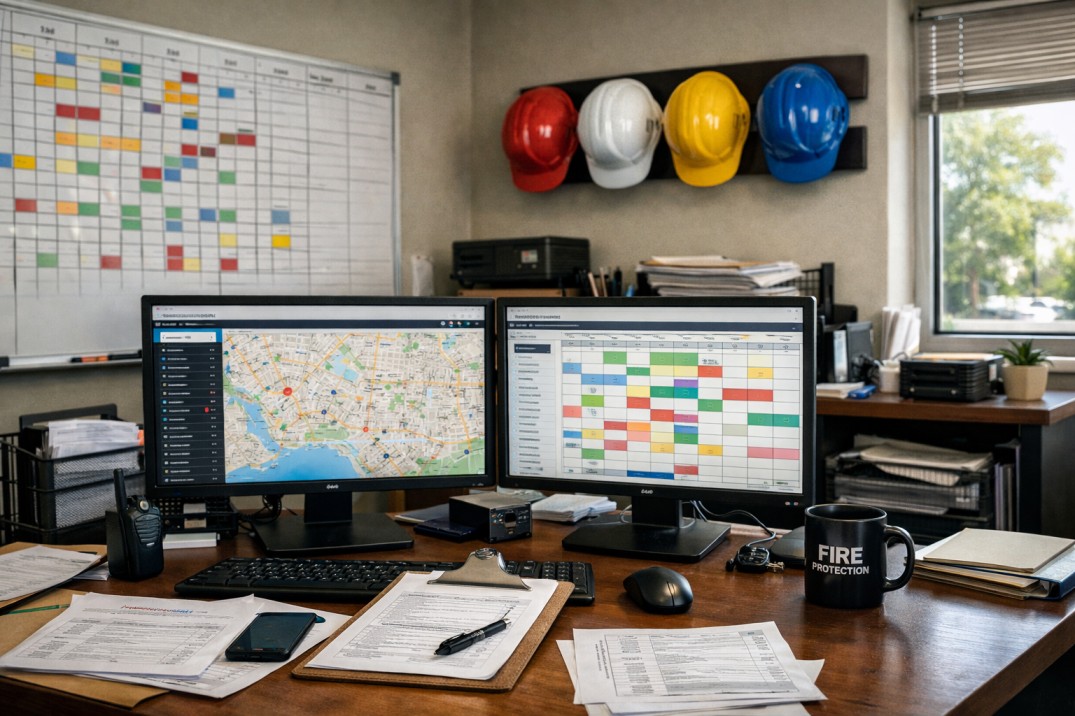
The companies that try to manage this with whiteboards and spreadsheets eventually hit a wall. One contractor described it perfectly: before switching to dedicated software, they had four employees overwhelmed with manual work just trying to track and schedule upcoming inspections. The due dates kept slipping, the paperwork kept piling up, and things fell through the cracks.
Technician Certifications Create Real Dispatching Constraints
Here's a problem that catches a lot of growing companies off guard. Your best sprinkler tech, the one who knows NFPA 25 inside and out and has a NICET Level III in Inspection and Testing of Water-Based Systems, can't touch a fire alarm panel. That requires a completely separate NICET certification in Fire Alarm Systems, and many states require additional licensing on top of that.
NICET alone offers five separate fire protection certification tracks: Fire Alarm Systems, Inspection and Testing of Fire Alarm Systems, Water-Based Systems Layout, Inspection and Testing of Water-Based Systems, and Special Hazards Suppression Systems. Each has its own exam, its own experience requirements, and its own three-year recertification cycle requiring 90 CPD points.
Then layer on the specialty certifications. Kitchen suppression technicians typically need manufacturer-specific factory training (your Ansul guy can't just walk up to a Kidde system). Fire extinguisher techs need NAFED certification. Fire door inspectors need IFDAI credentials. And every state does licensing differently. New Jersey requires separate contractor credentials for sprinkler, alarm, special hazard, and kitchen suppression work. Utah has a tiered system where Tech I can only do wet pipe and standpipes, while Tech II adds dry pipe, deluge, preaction, and fire pumps.
What does this mean for your dispatch board? You can't just send the closest available tech. You have to match certifications to the job, which gets complicated fast when you're running five service lines across three states. A recent industry survey found that 45% of fire protection technicians say miscommunication between field and office is their top productivity killer, and 44% cite poor scheduling or last-minute changes. When you're juggling multiple service lines with certification-constrained dispatching, those numbers make a lot of sense.
One Customer, Six Service Lines, One Confused Back Office
Let's say you land a 20-location restaurant chain as a customer. Great news for revenue. Terrible news for your quoting and contract management process if you're still doing things manually.
Each location needs kitchen hood suppression service (semi-annual under NFPA 96), portable extinguisher maintenance (annual plus the rolling six-year and twelve-year cycles under NFPA 10), fire alarm testing (annual under NFPA 72), and probably sprinkler inspections (quarterly and annual under NFPA 25). That's four different service lines with four different pricing models, four different visit cadences, and potentially four different technician skill sets required.
Bundling that into a single proposal is hard enough. Tracking the ongoing compliance across 20 locations, each with different equipment ages (meaning the six-year and twelve-year extinguisher cycles don't align across sites), different AHJ requirements, and different system configurations? That's where companies start losing money. Deficiencies go unquoted. Quotes sit in someone's email for weeks. Repair work never gets scheduled.
One operations VP at a multi-service company described the breakthrough moment: once they started tracking the full cycle from deficiency to quote to job to invoice in a single system, revenue jumped because nothing was getting missed anymore. That's not a technology story. That's a revenue recovery story.
Different AHJs, Different Rules, Same Headache
There are over 43,000 authorities having jurisdiction in the United States, and there is no federal fire code. One city might enforce NFPA 72-2019 while the county next door is still on the 2016 edition. For a multi-service company operating across jurisdictions, this creates a compliance tracking nightmare that compounds with every service line you add.
A single building might involve one AHJ (the electrical inspector) for fire alarms, a different AHJ (the fire marshal) for sprinklers, and a third (the building inspector) for fire doors. Each may want documentation in a different format, on a different timeline, with different retention requirements. NFPA 80 requires three-year record retention for fire door inspections. Other standards have different rules. Healthcare facilities throw in additional CMS requirements. And non-compliance penalties can run $500 to $5,000 per violation.
When you're managing one service line in one jurisdiction, you can keep the AHJ quirks in your head. When you're managing five service lines across a dozen jurisdictions, you need a system that tracks which code edition applies where, what documentation format each AHJ expects, and when everything is due. Trying to do that in spreadsheets is how things get missed during surprise audits.
Getting the Operational Foundation Right
The companies that run multiple service lines well, and actually make money doing it, tend to share a few things in common. They've centralized their scheduling, compliance tracking, and customer management into a single platform instead of running separate systems for each service line. They've mapped out their technician certifications and built dispatching rules around them. And they've automated the deficiency-to-quote pipeline so repair revenue doesn't disappear into the gap between field and office.
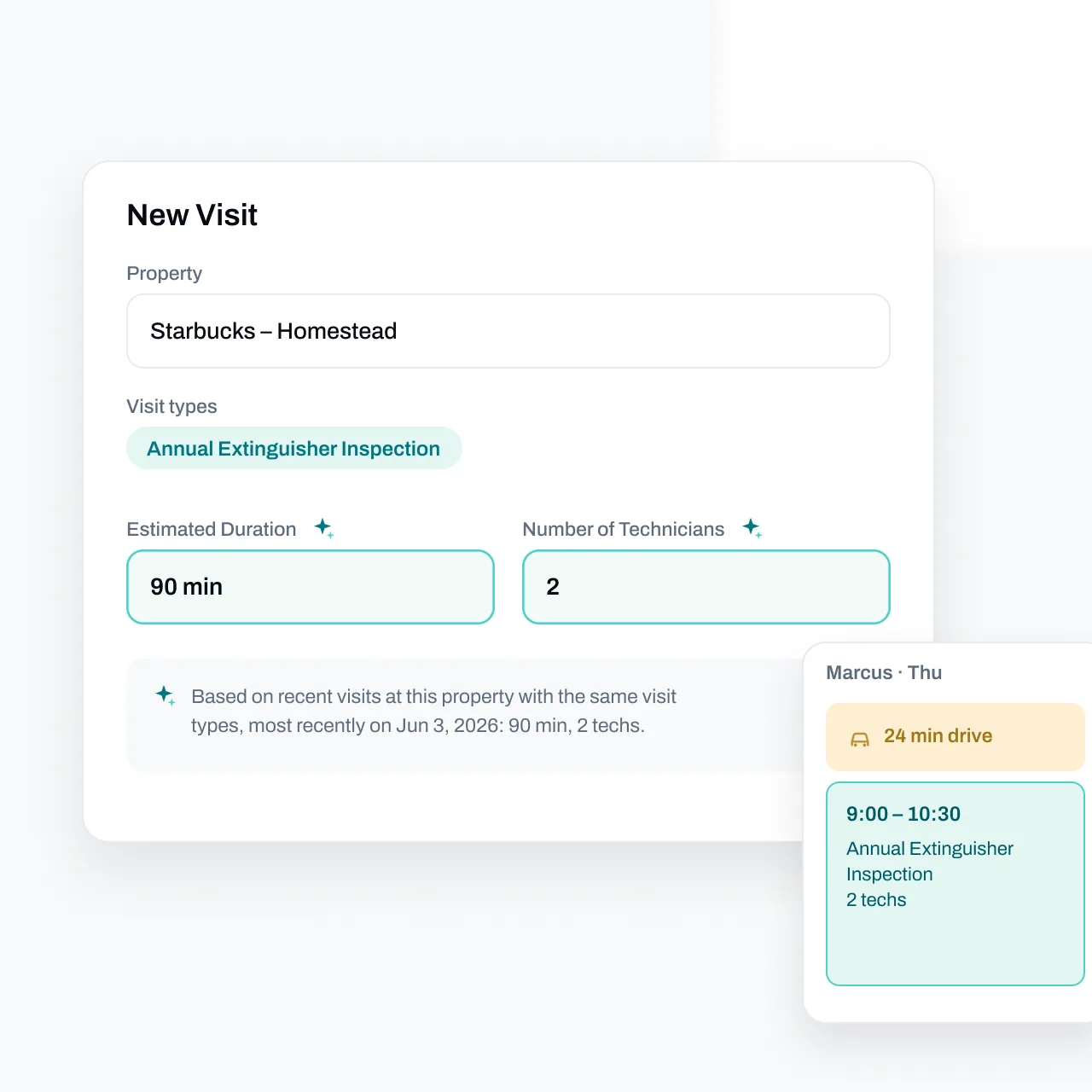
Platforms built specifically for fire protection, like Essential, include NFPA templates for each service line out of the box, so your alarm techs, sprinkler techs, and extinguisher techs are all working from the correct forms without anyone in the office having to manage separate systems. Automated inspection due date tracking with dynamic recalculation means the six-year extinguisher cycle, the quarterly sprinkler test, and the annual alarm inspection all stay on schedule without manual calendar management.
But whether you use Essential or another solution, the principle is the same: you can't run a multi-service operation with single-service tools. The complexity multiplies faster than most owners expect, and the companies that solve the operational problem first are the ones that grow profitably instead of just growing busy.
Your Techs Are Telling You Something
ServiceTrade's 2026 Technician Insights Report surveyed over 800 fire protection technicians and found something worth paying attention to. When asked what would most increase their productivity, the top answers were better coordination with the office (35%), better job planning (33%), and faster access to asset and service history (30%). These aren't complaints about the work itself. Techs love the work. The friction is operational.
In a multi-service company, that operational friction multiplies. Your alarm tech shows up to a site and the customer asks about a sprinkler deficiency from last month, but the tech has no visibility into the sprinkler team's notes. Your extinguisher tech notices a fire door with a broken closer, but there's no easy way to flag it for the door inspection crew. Your dispatcher is trying to route three different service types across the same geography but can't see all the schedules in one view.
The companies that figure this out, that give their techs and their office staff a single source of truth across all service lines, are the ones that retain their best people and deliver better service. In an industry facing a 14-20% skilled labor shortfall with over a quarter of technicians nearing retirement, keeping your people productive and happy isn't optional. It's survival.
Making Multi-Service Work for You, Not Against You
Adding service lines is smart business. Your customers want it, the economics support it, and the industry is moving that way whether you lead or follow. The question isn't whether to offer multiple services. It's whether your operations can keep up with the complexity that comes along for the ride.
Start with your scheduling and compliance tracking. If you can't tell me right now which of your customers have quarterly sprinkler tests due next month AND six-year extinguisher internals due in the same window, that's your first problem to solve. Then look at your quoting workflow. Every deficiency your techs find in the field that doesn't become a quote within 48 hours is revenue you're leaving on the table. Finally, audit your technician certifications against your service line offerings. Make sure your dispatching process accounts for who can actually do what, so you're not sending the wrong tech to the wrong job.
If you're running multiple service lines on spreadsheets and gut instinct, you already know it's not sustainable. If you want to see how a purpose-built fire protection platform handles multi-service operations, book a demo with Essential and bring your messiest scheduling scenario. That's usually where the conversation gets interesting.