
Twenty extinguishers in one warehouse and twenty spread across six storefronts are different jobs. A single price per extinguisher hides the driving, keys, parking, and report work that separate them.
For a contractor setting fire extinguisher inspection prices, start with the cost of the visit. Divide that cost by 1 minus your target job margin, then check that your minimum charge covers small stops. The example below shows the math for annual maintenance.
Define what “inspection” includes on your quote
Customers often use “inspection” to mean the annual contractor visit. Your scope should be more precise. OSHA 1910.157(e) separates monthly visual inspections from annual maintenance. Paragraph (e)(4) requires six-year maintenance for stored-pressure dry chemical units subject to a 12-year hydrostatic interval, with an exception for nonrefillable disposable containers.
A quote for annual maintenance shouldn't quietly absorb recharge, internal maintenance, hydrostatic testing, replacement units, or a second trip. List the included service, identify the units it covers, and state how you'll authorize additional work. Our NFPA 10 service guide helps separate the recurring tasks.
If your office rebuilds that scope for every customer, Essential's quote templates and saved line items give estimators a starting point. Check the quantities, access assumptions, and exclusions for each property before sending.
Ask for last year's report and asset list. If the customer has neither, allow time to find and identify every unit.
Calculate the visit cost before the per-unit price
Build the estimate around costs you can measure:
- Field labor: service time, site access, walking between units, and time waiting for an escort.
- Travel and vehicle cost: the route time and operating cost allocated to this stop.
- Materials: the tags, seals, and other consumables included in the quoted work.
- Office work: scheduling, report review, delivery, invoicing, and any required filing.
- Job-specific costs: parking, access permits, or other charges this customer creates.
Use loaded labor cost, including payroll burden, rather than the technician's wage alone. Decide where vehicle and office expenses belong in your model so you don't count them twice. Company overhead that isn't assigned to individual jobs still has to be covered by the margin.
Compare the estimate with completed jobs. Your fastest technician's best stop won't represent a route with locked tenant spaces.
A worked example: 40 extinguishers on one site
This hypothetical example assumes 40 units in an accessible building, an accurate inventory, and annual maintenance only. It illustrates estimating math, not market rates or a service productivity standard.
- Three technician hours, including travel, at a loaded cost of $55 per hour: $165.
- Half an hour of office work at $30 per hour: $15.
- Allocated vehicle cost and included consumables: $50.
Total estimated job cost: $230.
At a target job margin of 40%, divide cost by the portion of revenue available to cover it:
Price = $230 ÷ (1 − 0.40) = $383.33.
That's about $9.58 per extinguisher for this example. Different travel, scope, or access conditions will change the calculation.
Adding 40% to cost would produce $322 and a margin of about 28.6%. Markup and margin use different denominators. Put the formula in your estimating sheet so the office doesn't switch between them.
Use a minimum charge that matches the work
A two-extinguisher stop still needs a technician, a vehicle, and a completed report. Price that fixed effort explicitly. You can use a minimum visit charge, a service-call charge plus unit rates, or a site price with a defined inventory. Pick a structure your estimator can explain and your invoice can reproduce.
State whether a minimum includes the first units or applies instead of a lower calculated total. Otherwise, the customer may reasonably read your quote differently from your billing team.
Consider two neighboring shops receiving annual maintenance on the same morning. Shared travel may reduce your cost compared with separate appointments a week apart. Before offering a route discount, confirm the customer can provide the access it assumes.
Quote the exceptions while the facts are available
Record which units need additional work and why. Give the customer a clear approval path for that work, including any exchange units or return visits. Don't build the base inspection price around an assumption that every job will produce repair revenue.
The inspection revenue calculator can model inspection and repair revenue separately using your own inputs. Keep that distinction in the quote too.
Our guide to starting a fire extinguisher business covers the operating setup behind the scope you're selling.
Check the estimate against the completed job
After the visit, compare estimated and actual labor, unit count, materials, and office time. Record why they differed. “Customer had no keys for rear tenant space” is useful at renewal; “job ran long” isn't.
Essential's job costing uses clocked hours at each technician's cost rate and the cost of parts used. It compares those costs with job revenue to show gross margin. For jobs with linked quotes, the Estimated vs. actual report compares the quoted amount with actual cost. Keep allocated office and vehicle overhead in your estimating model as well.
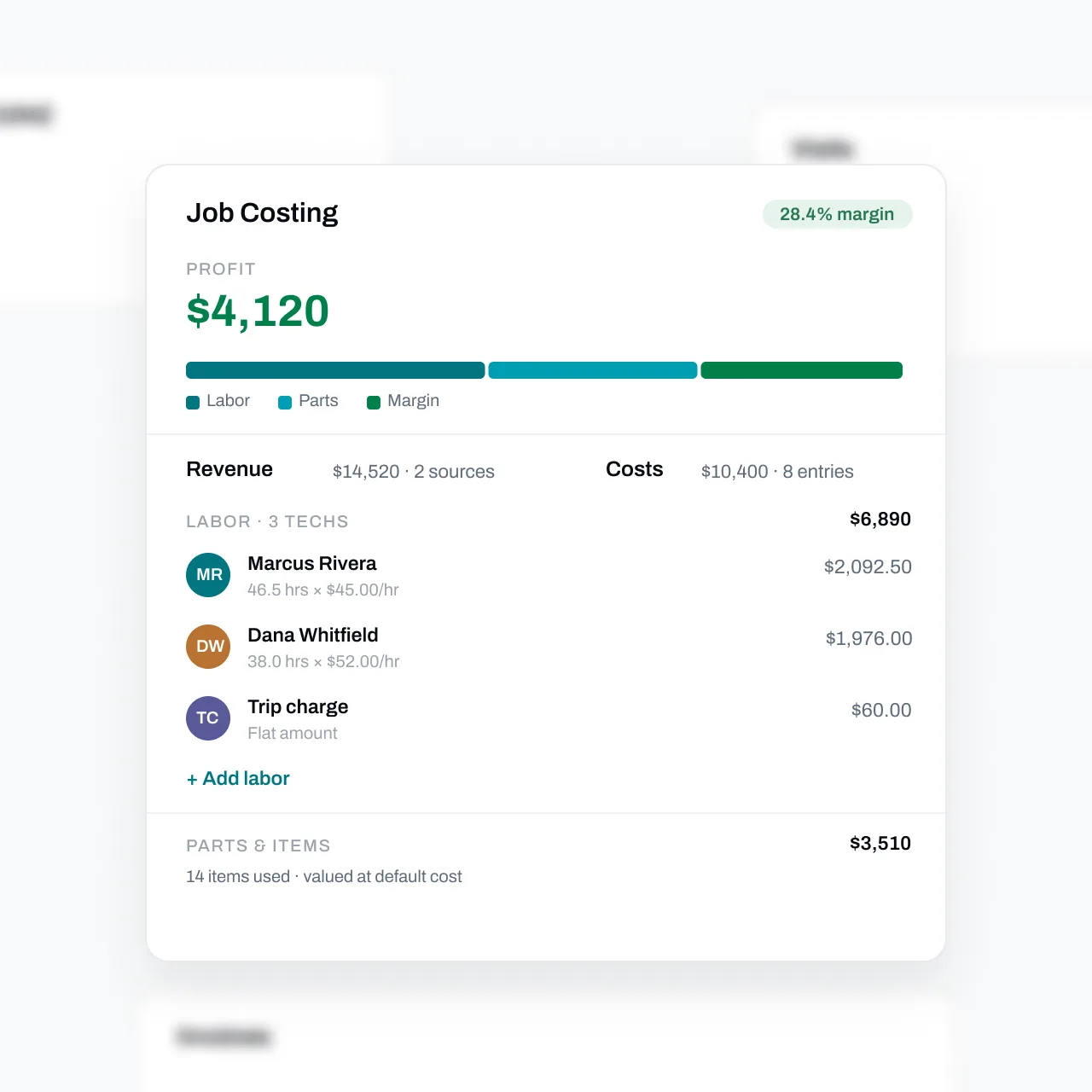
Book a 30-minute demo to see how a quoted extinguisher visit compares with its recorded labor, parts, and revenue. We can use a sample job; if you have a recent estimate to compare, bring it along.