
An annual inspection account still has to pay for the drive to the building. If you're a firefighter or technician starting out on your own, knowing the equipment won't tell you what to charge or how to keep customers' service dates from slipping.
NFPA 10 service schedules bring you back to customers year after year. You'll need a record of what each unit needs next so you can book the return visit. Equipment and training costs will limit which services you can offer at the start.
Before you spend months buying equipment and preparing to open, price the services you're licensed to sell.
Understand Why Fire Extinguisher Service May Be the Right Entry Point
Sprinkler, alarm, suppression, and passive fire protection work can require years of experience before you're ready to operate independently. You'll also have to budget for the equipment and advanced certifications those services require.
Fire extinguisher service has lower equipment costs and a shorter training timeline. Check the applicable NFPA 10 schedule for each extinguisher type before quoting annual inspections, 6-year internal examinations, or 12-year hydrostatic testing. These cycles bring you back to maintain equipment after a one-time sale.
Extinguisher inspections put you in regular contact with the person responsible for the building's fire protection. Ask who handles kitchen hood suppression service, fire alarm inspections, emergency light testing, and sprinkler ITM work. Those are potential additions to the account once you're qualified to perform them.
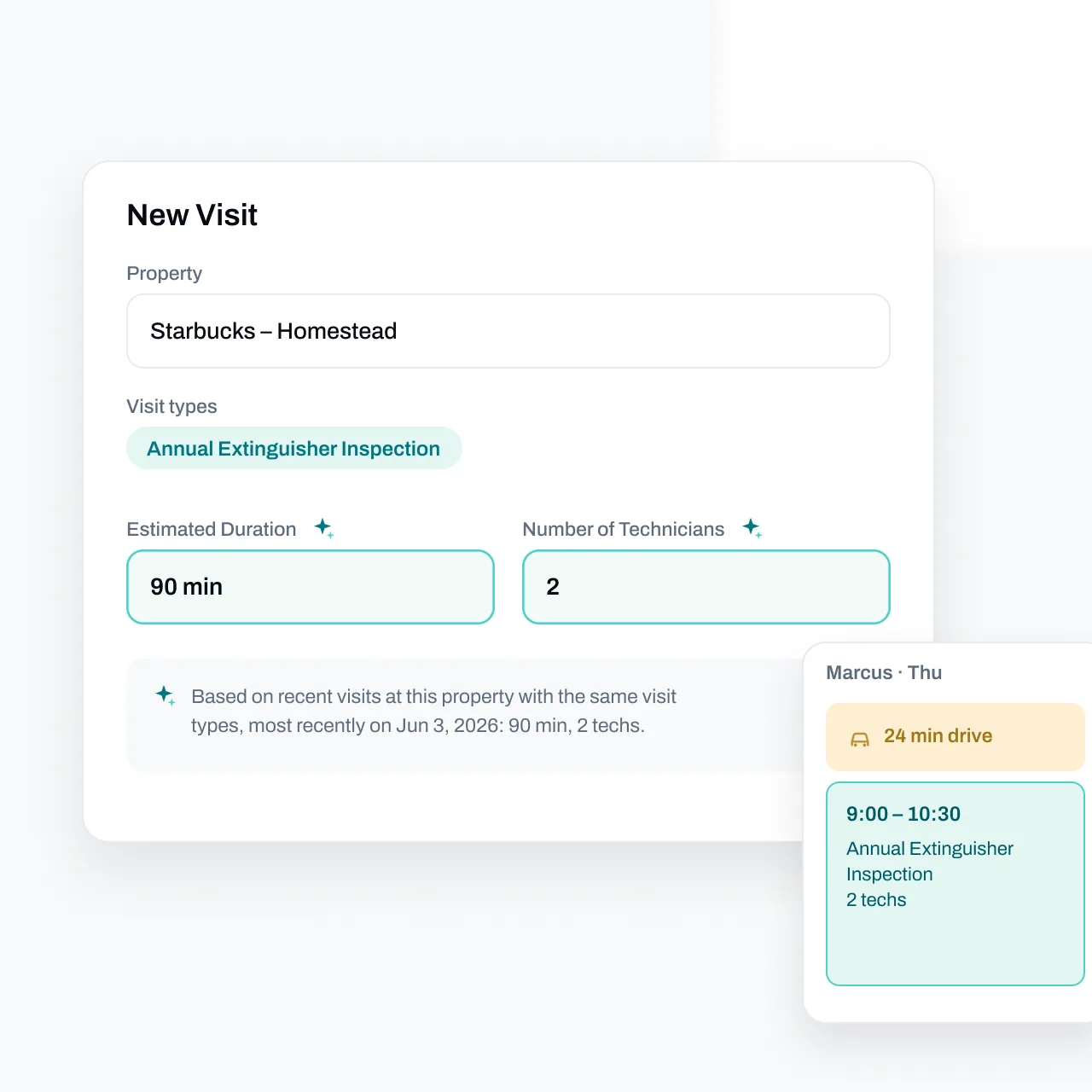
Before your first hundred customers, decide how you'll track each extinguisher's dates. Essential's fire extinguisher inspection software handles barcode scanning and due dates from day one. It also produces NFPA 10 reports; the 30-minute demo includes that workflow.
Get Licensed and Certified Before Anything Else
Get licensed before accepting work. State rules differ, and operating without the required license can carry penalties ranging from fines to criminal charges.
Your state's Fire Marshal's Office or Department of Insurance generally issues both a company license and individual technician licenses. You'll need both to operate.
In Texas, you'll need a Fire Extinguisher Certificate of Registration for the company and a Type B Portable license for each technician, which requires passing either the state TFM02 exam or the ICC/NAFED Certified Portable Fire Extinguisher Technician exam. In California, OSFM issues a Concern License for the company and individual Certificates of Registration that require passing a Pearson VUE exam. Florida requires a certification course at the State Fire College, fingerprint processing, and continuing education every two years.
The ICC/NAFED Portable Fire Extinguisher Technician certification is a 100-question, open-book exam with a 2-hour time limit and a 75% passing score. It costs around $320. Before you book, check whether your state requires it or accepts it in place of its own exam.
Check city and county licensing requirements too.
In New York City, FDNY requires a Company Certificate of Approval and individual W-96 Certificates of Fitness. Only approved companies can purchase FDNY's standardized tags. Nassau County and Suffolk County each have separate requirements too.
Missouri has minimal fire extinguisher licensing at the state level. Check with your local AHJ (Authority Having Jurisdiction) for rules that apply where you'll work.
Before you spend a dollar on equipment, give your state Fire Marshal's office and local fire department the scope of work you plan to offer. Ask which licenses and permits apply, including any certifications required for that work.
Handle the Business Formation Basics
Work through the business setup while you're getting licensed:
- Form an LLC. Ask your attorney about separating business liabilities from personal assets if an extinguisher you've serviced fails. State filing fees run $50 to $500 depending on where you live.
- Get your EIN. It's free from the IRS and takes about 10 minutes online. You'll use it to open your business bank account. It's also needed for tax filing and hiring.
- Open a dedicated business bank account. Keep business and personal finances separate from day one so you can trace business transactions for tax records and maintain the separation your LLC needs.
- Register with your state and local government. Get business licenses and any permits your city requires. You'll also need sales tax permits for the replacement extinguishers and parts you'll sell.
Get the Right Insurance (This Part Matters More Than You Think)
Bring the broker a description of your work before you buy a policy. Ask how coverage applies if an extinguisher you've serviced fails during a fire and a customer makes a claim.
You'll need these types of coverage:
General liability with $1M per occurrence and $2M aggregate. Most property managers require proof of GL before they'll hire you. Budget $800 to $2,500 per year.
Professional liability (E&O) needs to cover fire protection service work explicitly. Standard GL policies sometimes exclude "failure to perform" claims, the kind you'd face if a serviced extinguisher failed. Budget $700 to $1,200 per year.
Workers' compensation is required in nearly every state once you hire employees. For a small crew of 1 to 5 technicians, plan on $2,000 to $5,000 per year.
Commercial auto for your service vehicle runs about $1,500 to $2,500 per year.
Expect to spend $7,000 to $12,000 per year on insurance as a small startup. Get quotes from a broker who works with fire protection contractors. AMIS and Allied Insurance Managers both focus on this industry. You won't find fire protection coverage with every carrier.
Know What Equipment You Actually Need (and What Can Wait)
You can outsource hydrostatic testing on day one while handling annual inspections and 6-year maintenance yourself. Wait to buy hydrostatic test equipment until the volume of work you've sold can support the purchase.
For annual inspections and 6-year maintenance, you'll need:
Valve tools and wrenches, O-ring kits, a mechanical bench vise, inspection tags, tamper seals, verification-of-service collars, and a dry chemical filling system for recharges. You'll also need brand-specific recharge adapters: Amerex, Badger, Kidde, and Buckeye use different valve configurations.
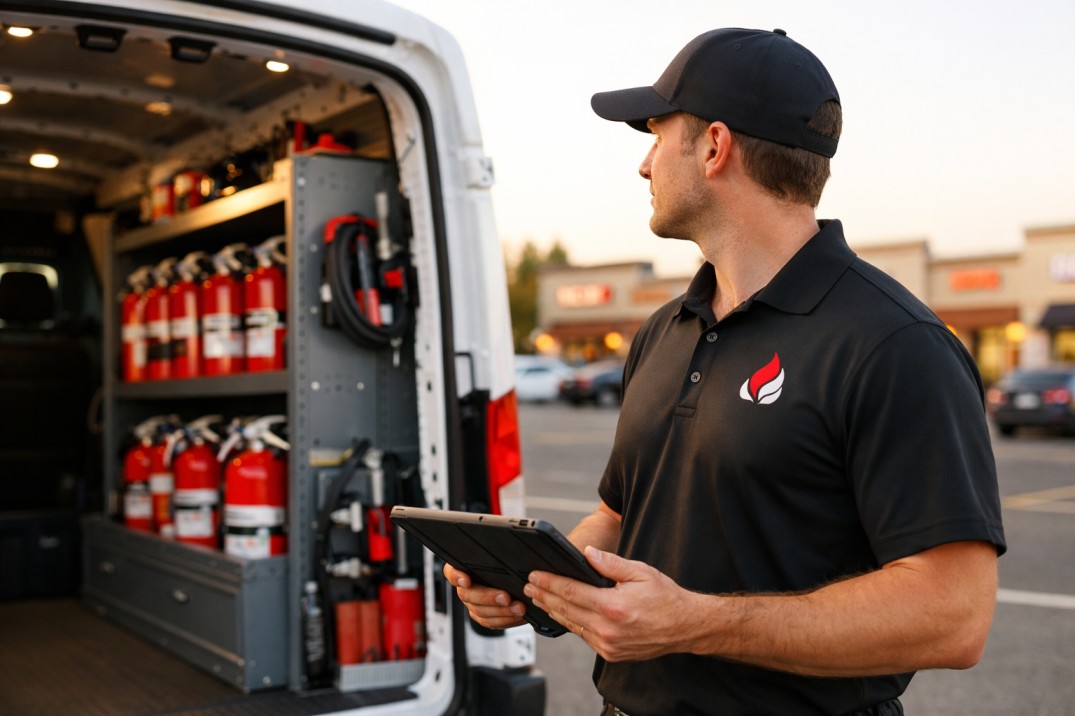
A cargo van such as a Ford Transit, Chevy Express, or RAM ProMaster needs shelving and bin storage. Used vans run $25,000 to $40,000, and outfitting adds another $3,000 to $8,000. A wrap with your company name and phone number adds $500 to $2,000 and advertises your service wherever you park.
Plan an initial inventory of 30 to 50 replacement extinguishers, plus agents and common replacement parts. Budget $3,500 to $9,000.
Use a tablet and barcode scanner with fire protection inspection software. At 200+ extinguishers across multiple buildings, paper tracking leaves more room for missed due dates and 6-year cycles. Check the NFPA 10 record-keeping requirements (Section 7.2.4) in your adopted edition when setting up records. Digital tracking can reduce duplicate entry and help you find what's due. Budget $1,500 to $4,000 for first-year technology costs.
Startup costs by approach:
If you start with inspections only and outsource recharging and hydrostatic testing: $32,000 to $55,000.
If you add recharge capability and 6-year maintenance but still outsource hydrostatic testing: $48,000 to $80,000.
If you buy hydrostatic test equipment from the start: $70,000 to $123,000.
Starting with inspections only keeps equipment spending down while you build routes. Add recharge capability when customer demand warrants it; tools bought ahead of the work can sit idle for months.
Price Your Services to Win Work Without Going Broke
Set a service call minimum that covers the trip and setup. Charge per unit for the inspection work, then check the account's labor and travel costs before offering a volume discount. A larger extinguisher count doesn't automatically make a visit profitable.
Service call minimums typically range from $80 to $120. Set yours to cover drive time and setup even when the customer has only three extinguishers.
Per-unit annual inspection pricing scales with volume. For 1 to 10 units, $25 to $30 each is standard. At 11 to 25 units, you're looking at $20 to $25. For 26 to 50, $18 to $22. Above 50 units, $15 to $20. Large accounts with 200+ units can go as low as $12 to $18 per unit.
6-year internal examinations run $40 to $80 per unit. Hydrostatic testing is $50 to $100+ per unit. Recharges are $40 to $150 depending on agent type and extinguisher size.
A small office with 8 extinguishers is a $220 to $320 annual account. A restaurant with 12 units, including Class K kitchen extinguishers, generates $375 to $500 per year. A 60-unit apartment complex brings in $1,300 to $1,800 annually. With 50 to 100 accounts, group nearby buildings on the same route to control travel costs.
Don't cut the rate below what the work costs. Document deficiencies and keep track of each 6-year exam. The service record should show the owner what needs attention and when it's due.
Land Your First Customers
Your first 10 to 20 accounts take direct outreach. Start with local buildings you can serve on a workable route.
Build relationships with your local AHJ. Fire marshals and fire inspectors visit commercial buildings on a regular cycle, usually every one to two years. They require owners to correct expired tags and extinguisher violations. During your first year, ask whether the department keeps a referral list of licensed service companies and what it takes to be included. Bring your licenses when you introduce yourself.
Walk commercial districts. Visit strip malls, office parks, and industrial areas. Introduce yourself and leave a card. Ask who's responsible for service, and discuss tag dates with the owner when you have access. Follow up in two weeks. In year one, keep a record of these contacts so you know whom to call back.
Target property management companies early. A single property manager may bring 5, 10, or 20 building accounts. Ask which buildings they manage and when extinguisher service is due at each property.
Consider government contracts. Check SAM (System for Award Management) registration requirements, including whether the DUNS number guidance still applies. Look for small fire protection contracts on your local government's procurement site. Read the payment terms and service schedule before bidding; you'll be fitting these jobs around the commercial accounts you're building.
Keep your Google Business Profile current. Building owners may search "fire extinguisher service near me" after a fire marshal citation. List your service area and phone number, and ask satisfied customers for reviews.
Include restaurants in your outreach. They need standard ABC and Class K kitchen extinguishers, and many require semi-annual kitchen hood suppression inspections. That's more service visits per year than a standard office.
Set Up Systems That Scale From Day One
At 30 or 40 accounts, an overdue 6-year exam can disappear in an outdated spreadsheet. A quote for three replacement extinguishers can stay unsent while the deficiency notes sit in the van. Assign responsibility for updating due dates and sending quotes before you add more accounts.
Check NFPA 10's documentation requirements for each inspection and maintenance event, as well as each hydrostatic test. For each unit, record service details with the date and technician identification. Across hundreds of extinguishers at dozens of locations, the office needs records it can find without calling the technician.
Fire protection software like Essential supports inspection tracking, automated due date recalculation, deficiency documentation, and field quoting. A technician who finds a corroded extinguisher during an annual inspection can log the deficiency with photos and prepare a replacement quote. The customer can receive the quote the same day instead of waiting two weeks for the office to work through paper notes.
Set up digital service records before you start adding accounts. Once you've reached 100 accounts, transferring their service histories competes with time needed for inspections and customer calls.
Plan Your Growth Path Beyond Extinguishers
Before you add a service line, ask existing customers whether they need it. Budget for the training and equipment required to do the work.
A possible progression is extinguishers (NFPA 10), kitchen hood suppression systems (NFPA 96/UL 300), fire alarm inspections (NFPA 72), sprinkler system ITM (NFPA 25), and exit and emergency lighting. You'll need additional certifications and training for each service before selling it.
An account worth $500 a year for extinguisher inspections might bring $3,000 to $5,000 a year if you add alarm testing and sprinkler inspections along with kitchen suppression service. Price the added work against its labor and equipment costs.
Pye-Barker, CertaSite, APi Group, and private equity buyers have bought dozens of smaller fire protection companies in recent years. If you're considering a sale, research those acquisitions. Clean documentation supports valuation. Having at least 50% of your revenue from service contracts tends to strengthen your company's valuation multiple.
You don't need an exit plan on day one. File recurring contracts with the corresponding service records so you can see which accounts are producing repeat work.
Stay Current on Codes and Build Your Reputation
Check which NFPA edition your state or local AHJ has adopted; adoption dates can differ from the publication cycle. The 2022 edition of NFPA 10 updated signage requirements and electronic monitoring clarifications. For a signage question, have the applicable text ready to show the owner.
Join your state fire protection association and consider NAFED or AFSA membership. At trade shows and conferences, ask other contractors how they've handled equipment or licensing questions that have come up on your jobs.
Ask satisfied customers for Google reviews and respond professionally. A property manager comparing three fire extinguisher companies may favor one with 47 five-star reviews and detailed responses over one with no online presence.
The Bottom Line
The fire protection industry in the US is worth over $22 billion and growing. The portable fire extinguisher market is projected to reach $5 billion by 2030. There are roughly 4,000 fire protection companies serving the country, compared with 70,000 electrical contractors. National totals won't tell you how much competition you'll face on your own routes.
Decide which services you'll sell before you buy equipment. Use the prices above to draft a budget, then compare it with equipment and insurance quotes for the work your licenses allow.
Essential's free 30-minute demo covers inspection tracking and quoting for fire protection contractors setting up software from day one. The team also walks through scheduling. There's no commitment.
Before your first route, read our guides on how to price fire extinguisher inspections and fire extinguisher inspection tag requirements. Use them to check your visit price and make sure each tag matches the service record in year one.
The software side of your new business
Essential's fire extinguisher inspection software keeps service dates and findings together. Setup and data migration are free, with month-to-month terms and no contract lock-in.