
NFPA 72 2025 became effective September 18, 2024. It changes how you design, install, test, and document fire alarm systems. For contractors, that means revised inspection forms, tighter testing schedules, and new duties in service contracts. Confirm the adopted edition with the AHJ before applying these changes.
Our 2026 best fire protection software ranking compares tools for managing fire alarm inspections across service accounts.
Federal projects already require the 2025 edition. State and local jurisdictions will adopt it over the next one to three years, with California implementing it as early as January 1, 2026. That schedule leaves contractors time to update forms and train technicians before local adoption.
The changes reach the field and the office. Test calendars, drawings, and notification procedures all need attention.
Cybersecurity scope and records
Chapter 11 cybersecurity requirements are now enforceable code. Previously, cybersecurity guidance sat in an annex. The 2025 requirements apply to any network-connected fire alarm equipment.
Systems with IP connectivity, cellular communicators, or cloud-based monitoring now require documented cybersecurity protocols. Those protocols include security levels based on equipment access and regular security updates following ANSI/ISA standards. Configuration controls must prevent tampering.
The 2025 edition adds a definition for "Network Connectable Equipment": any system component connecting to the internet or external systems. Each system requires documentation of who has access, procedures for removing credentials when personnel change, and access management protocols.
During inspections, technicians must document that cybersecurity measures are in place. An addressable panel's network connections now bring security records into the inspection work. Keep those records with the equipment documentation so technicians can account for access changes during service.
Essential's fire alarm inspection software includes NFPA 72 templates and test scheduling. Bring a current form to a 30-minute demo to see how the new documentation fields and testing frequencies fit your service accounts.
Smoke detector height limits affect spacing
The 2025 edition of NFPA 72 sets a maximum ceiling height of 40 feet for traditional smoke detector placement methods. Prescriptive 30-foot spacing no longer applies regardless of height. Check ceiling height before laying out detectors or pricing the installation.
Above 40 feet, performance-based design spacing is required. That means engineering calculations and documented performance objectives. Warehouses, atriums, and manufacturing facilities with high ceilings may need a fire protection engineer involved in the design.
NFPA Fire Protection Research Foundation studies found that smoke behavior changes significantly in high-ceiling applications, prompting the new limit. If you're estimating one of these projects, include engineering services in the price. Explain the design work to the customer before the installation price is settled.
Device testing frequencies and notice deadlines
Control valve supervisory devices and waterflow alarm devices now require both inspection and testing semiannually. Previously, inspection was twice a year and testing was annual. The 2025 edition doubles the testing workload for those components. You'll need to budget for the added testing on each service account.
Other supervisory devices retain semiannual inspection and annual testing. Update service contracts and inspection calendars to separate the two schedules. Customers need to see which devices require another test and how that changes the service price.
The 2025 edition shortens impairment notification to the building owner from 24 hours to eight hours after discovery during an inspection. Deficiencies still require written notice within 24 hours. An impairment that could cause system failure during a fire emergency now carries the shorter deadline.
That eight-hour window requires a way to send notice from the field. A technician can call the owner, then send email confirmation, or use a digital reporting system to issue the notification. Waiting until the report reaches the office can consume the reporting window.
Record splice and junction locations on shop drawings
NFPA 72, Chapter 7, now explicitly requires shop drawings to document all splice and junction locations. Major components alone aren't enough. Those locations become part of the installation record that later inspection and maintenance work depends on.
A circuit fails three years after installation. You're tracing it, but the drawings don't show the splices or junction boxes. You have to find those connections before isolating the fault. Recording locations during installation saves that search during maintenance.
The code adds maintenance plan requirements for network-connected equipment. Plans must identify personnel with system access and procedures for removing credentials when personnel change. These records connect the maintenance work to the Chapter 11 cybersecurity requirements.
Restricted Audible Mode Operation systems require annual occupancy reviews and documentation of compliance. Put that review on the inspection checklist and in the recurring service agreement so the occupancy record stays current with the system's use.
Restricted Audible Mode Operation for sensitive occupancies
NFPA 72 2025 introduces Restricted Audible Mode Operation, or RAMO, for areas where loud alarms could adversely affect occupants. Applications include facilities serving people with autism spectrum disorder or other neurodiverse occupants, early education classrooms, and people with sound and light sensitivity.
RAMO zones require 520 Hz audible notification at private mode sound levels, 10 dB above average ambient. They also require trained staff who are awake and mobile, plus annual testing with documentation. The zones must be clearly marked on design drawings.
RAMO adds a specialized design and testing protocol for healthcare facilities, special education schools, and similar occupancies. Train the technicians assigned to those accounts on the notification requirements and the annual review before their next inspection.
Battery inspection shifts toward shelf life
Battery inspection now focuses on the "best by" date and at least 60% of shelf life remaining. That replaces the emphasis on manufacture dates and calculated battery age. Inspection forms need fields for the best-by date and remaining shelf life.
The rechargeable secondary-power battery listing requirement began in 2022 and became enforceable January 1, 2024. All rechargeable batteries used as secondary power must be listed by a nationally recognized testing laboratory. UL-listed batteries meet that requirement; non-listed batteries create code violations.
The battery correction factor remains 25%, up from the previous 20%. That safety margin accounts for capacity lost through degradation over time. Carry the factor into battery sizing and equipment specifications, and include capacity in annual inspection work.
Acoustic leak and thermal image detection
The 2025 edition adds two detector types: acoustic leak detectors and thermal image fire detectors. Both now have dedicated code coverage for installation and testing, expanding the equipment your technicians may encounter on service accounts.
Acoustic leak detectors use ultrasonic sound detection to identify gas leaks from high-pressure release in industrial environments. Thermal image detectors use long-wave infrared imaging with focal plane arrays to detect temperature changes and fire signatures.
Chapter 17 now includes sections 17.11 and 17.12 covering these detection methods. Installation requirements address clear lines of sight, performance-based design documentation, and alignment with manufacturer instructions. Both technologies also require specialized testing procedures.
Your technicians may encounter these detectors during inspections before your company installs them. Give them the equipment's testing procedures with the service record so they can prepare for the devices on that account.
Auxiliary Service Provider responsibilities
The 2025 edition formally defines Auxiliary Service Providers, or ASPs. These cloud-based services receive signals from protected premises and forward them to supervising stations, often through IP or cellular communicators. The code sets requirements for that part of the communication path.
ASPs must supervise communication paths every 90 seconds and meet UL 827 standards. They must retain signal records for at least one year. Implementation or changes require written notice within 30 days to the building owner, AHJ, and supervising station.
Name the ASP and its duties in service documentation and contracts. The office then has a record of who's responsible for signal forwarding, retention, and notice when the service changes.
Emergency Control Function Interface placement
Emergency Control Function Interface devices can now sit up to 20 feet from the controlled component when cabling is in metal raceway or armored cable. The previous limit was 3 feet unless the installation met special requirements.
The added distance gives installers more room to place ECFI devices for elevator recall, HVAC shutdown, or door release. Include the required raceway or armored cable in the layout and estimate when using the 20-foot allowance.
Check findings before closing the job
Reconcile inspection findings with the contracted tests before closing the report. Batteries, missing records, and building system interfaces deserve specific entries, with each finding tied to the affected device or function.
Battery inspection should cover failures and insufficient capacity. Look for missing replacement date labels or unlisted batteries, and review whether testing was adequate. Record the best-by date and shelf life alongside the capacity findings so the report captures the 2025 requirements.
Incomplete Records of Completion, missing as-built drawings, and gaps in maintenance logs leave the next technician without a reliable system record. Shop drawings that omit splice locations create the same problem. Missing records can extend downtime while someone traces connections or reconstructs the installation history.
Fire alarm interfaces with elevator recall, HVAC systems, fire door release, sprinkler monitoring, and other building systems require verification during annual testing. Book the other trades before the visit. Coordination belongs in the test schedule so every required interface gets tested.
POTS line retirement puts monitoring at risk on systems using traditional phone lines. Moving to performance-based IP or cellular technologies requires compatible control panels and proper configuration. Schedule the upgrade while the existing path still carries signals, allowing the owner time to budget for the work.
Keep inspection schedules and records together
NFPA 72 2025 puts more detail into each account's inspection schedule and records. Software can keep device test frequencies beside the forms technicians use, with previous inspection documentation available during the visit.
At an annual inspection, the technician tests control valve supervisory devices, which now also need a semiannual test. The form captures battery best-by dates and shelf life calculations, network access management, and RAMO compliance for accounts using that mode. Each task produces a record the office needs to retain.
With paper forms and spreadsheets, you're tracking different device frequencies, record retention periods, and notices to multiple recipients. Reports also need individual device listings. Reentering those details after the visit adds work between the field findings and the owner's report.
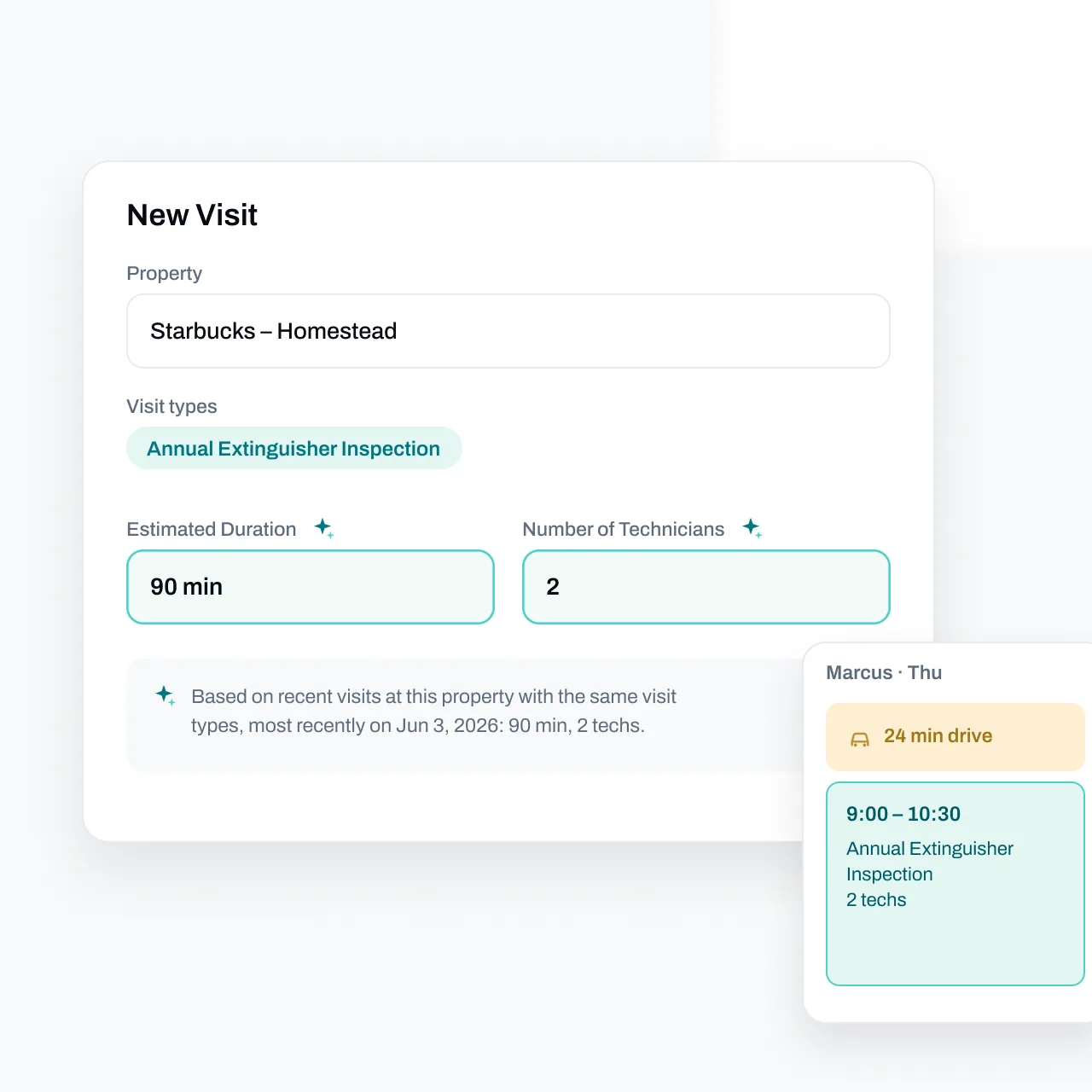
Fire protection management platforms such as Essential provide digital forms with NFPA requirements, automated scheduling, and mobile data collection. Central records retain documentation for each system's life. Reports separate impairments, with eight-hour notification, from deficiencies, with 24-hour notification, and observations, which are recommendations for future consideration.
Automated scheduling keeps semiannual and annual work on the calendar for the same system. Reports generated from field data carry each device's location and condition into the inspection record. The office can compare that report with the device list. It doesn't have to rebuild the record from handwritten notes.
Customer portals give building owners access to inspection reports and deficiency reviews. Owners can approve correction quotes and view compliance status across their properties. Building owners remain responsible for NFPA 72 compliance, so report handoff is the time to explain which findings need attention.
An impairment notice starts with a finding in the field. Connecting that finding to the owner's contact record lets the technician send notice within eight hours and retain the notification time. The office gets the same record for scheduling repairs and following up with the customer.
Integration with other codes
NFPA 72 intersects with NFPA 1 (Fire Code), NFPA 25 (Inspection, Testing, and Maintenance of Water-Based Fire Protection Systems), local fire codes, and OSHA requirements. Fire alarm work often sits within more than one set of requirements on the same job.
NFPA 1 references NFPA 72 as the governing standard for fire alarm systems. High-rise buildings, mass notification systems, and emergency voice alarm communication systems involve requirements from both codes. The design and service records need to account for that overlap.
Local AHJs adopt NFPA 72 on different timelines and sometimes add amendments. Some fire marshals require automatic submission of inspection reports; others want reports available on request. Keep the edition, amendments, and submission instructions in each jurisdiction's account records so the office sends reports through the right process.
OSHA doesn't directly enforce NFPA 72. Systems compliant with it generally meet the fire detection requirements in OSHA 1910.164. OSHA can also use NFPA standards as evidence of recognized hazards under the General Duty Clause. Complete testing, maintenance, and emergency response records serve both NFPA 72 compliance and OSHA requirements.
Match technician qualifications to the work
For NFPA 72 2025 service work, Section 10.5.3.4 requires personnel to meet one of four qualification routes. These are factory training and certification for the system; certification by a nationally recognized organization, such as NICET, acceptable to the AHJ; state or local registration or licensing; or employment by an organization listed by a nationally recognized testing laboratory.
NICET Level I represents entry-level competence. Level II requires two years of experience with installation and testing skills. Level III requires five years of experience with design capabilities, while Level IV represents ten years of experience with advanced technical management abilities.
Network connectivity and cybersecurity add to the knowledge technicians need for inspection and maintenance. Training also needs to cover performance-based communications and specialized detection methods. Match code updates and manufacturer-specific training to the equipment on your service accounts.
Building owners request proof of technician qualifications, and AHJs may review them during inspections. Keep current certifications and documented training records available with the service team's records. Those documents show the qualifications behind the work.
Put confirmed changes into service work
Specify "NFPA 72, 2025 edition, Chapter 14" in service contracts and define the inspection, testing, and maintenance scope. A general reference to NFPA 72 leaves the work less clearly defined. Design verification requires a professional engineer and belongs in a separate scope.
Revise inspection forms for semiannual control valve supervisory and waterflow device testing. Add battery shelf life fields and network cybersecurity documentation. Forms for RAMO systems need annual occupancy reviews, and shop drawing checks must cover splice and junction locations.
Put eight-hour impairment reporting in the field instructions. Specify phone calls followed by email confirmation or reporting software that sends the notice. Record when notification occurred and keep that record with the finding so the office can follow up on the impairment.
Review communication path vulnerabilities across service accounts. Discuss the POTS transition to performance-based technologies with each affected customer while monitoring still works. It's a capital expense. Planning gives the owner time to budget and your team time to schedule the change.
For network-connected systems, keep access management records with the authorized personnel list and credential removal procedure. You'll need to coordinate with the customer's IT department when it controls access or configuration. Personnel changes need to reach the team maintaining those records.
Train technicians on the 2025 changes before issuing revised forms. Cover testing frequencies and reporting deadlines alongside documentation requirements. Match factory training to the equipment they'll service, and use NICET programs or continuing education to address gaps in code knowledge.
Prepare forms for the accounts affected
NFPA 72 2025 adds cybersecurity duties, expands documentation, introduces detection technologies, and tightens testing schedules. Each change needs a place in the account's forms or service plan, with technicians prepared for the work before the next visit.
Assign form changes before renewing service contracts. Explain added tests and changed reporting deadlines to each customer. Give technicians the revised forms during training so they can work through the fields they'll fill out and practice sending an impairment notice.
NFPA 72 2025 already governs federal projects, with state and local adoption spreading over the next few years. Use that time to price the added testing, update service agreements, and schedule training before the new edition reaches more accounts.
Before applying NFPA 72 2025 to an account, confirm local adoption and amendments with the AHJ. Put the resulting edition and service schedule in the job record for the technician and the office.
Build the revised forms around our fire alarm inspection and testing checklist. Keep the smoke detector sensitivity testing guide beside it when setting the service plan, since sensitivity tests follow their own schedule.
Software built for NFPA 72 inspections
Essential's fire alarm inspection software includes NFPA 72 templates and automated scheduling, with deficiency tracking and inspection reports. Bring your forms to the demo and follow an impairment finding through the notification process.