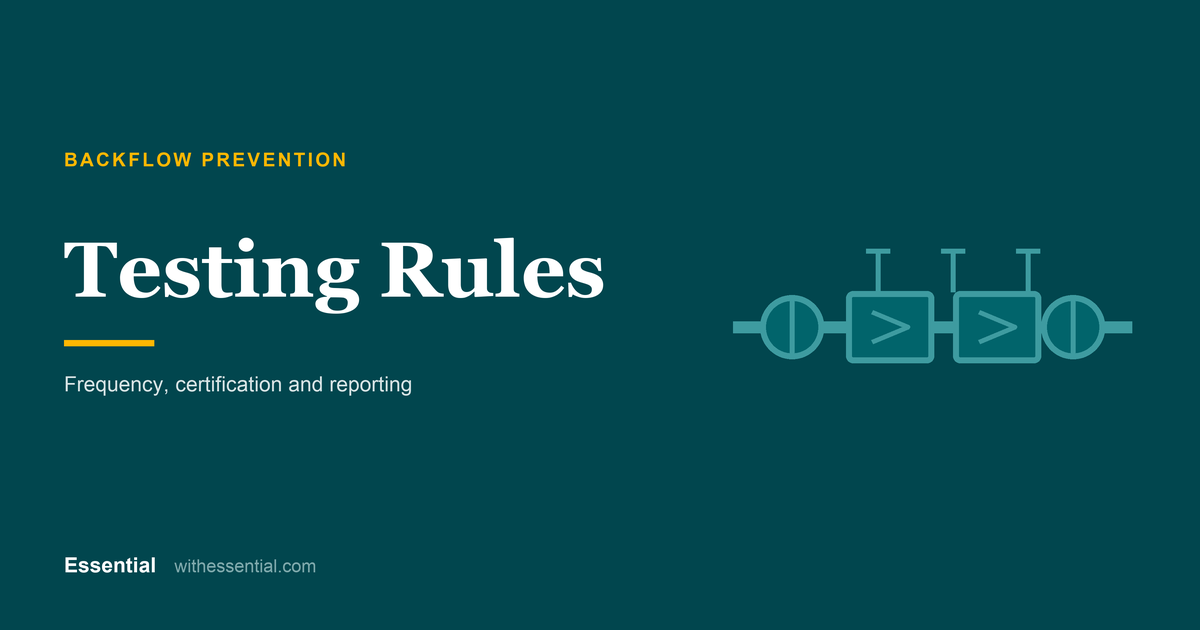

Backflow testing sits between the plumbing code, the local water purveyor, and NFPA 25, which is why the requirements feel inconsistent. Confirm specifics with your purveyor and AHJ.
Backflow Testing Requirements: Frequency, Who Can Test, and Reporting
A backflow preventer stops contaminated water from flowing back into the potable supply. Because the failure mode is public health, the water purveyor mandates and enforces testing, rather than the fire code official.
That one difference drives most of the confusion on fire lines.
How often testing is required
Annually is the near-universal baseline for testable assemblies. Some jurisdictions and hazard classifications require more. Assemblies also get tested after installation, repair, or relocation.
Fire sprinkler systems carry a second, separate obligation. NFPA 25 requires a forward flow test of the backflow prevention assembly, commonly annually, confirming the system still delivers full demand through the device. That's the only backflow test NFPA 25 itself mandates. The purveyor's annual assembly test is a separate requirement, and doing one doesn't satisfy the other.
Who can perform the test
Only a certified backflow assembly tester can perform the test. The state, county, or purveyor issues that certification, on a renewal cycle. Gauges need annual calibration, and purveyors reject reports written off an out-of-calibration gauge.
Entirely avoidable. Still happens every year.
Assembly types you'll encounter
- RPZ / RP: reduced pressure zone, for high hazard applications
- DCVA: double check valve assembly, common on fire lines
- DCDA: double check detector assembly, fire service with metered bypass
- PVB: pressure vacuum breaker, common on irrigation
Each has its own procedure, pass criteria, and report form.
Reporting is where most violations happen
The job closes when the report reaches the purveyor, on their form, inside their deadline. A passing test on its own closes nothing. Deadlines run a set number of days from the test. Late reports draw violation notices, sometimes water shut-off notices, on assemblies that passed.
A tech tests a DCDA on a warehouse fire line in March. It passes, he marks the job complete, and the signed form rides in the truck binder. Nobody owns the filing step. That purveyor's window was 10 days. The office finds out when the violation notice arrives, and someone re-tests a device that was never deficient. Two hours of admin — on a form that sat in a binder.
Contractors across several municipalities juggle a different form, portal, and deadline for each. That's the real problem in backflow work, and none of it is technical.
Common deficiencies
- Report filed late, or to the wrong purveyor
- Test gauge out of calibration
- Assembly not repaired and retested after a failed test
- Shutoff valves left partly closed after testing, dangerous on a fire line
- New or replaced assemblies never registered with the purveyor
- Forward flow test assumed covered by the annual assembly test
Frequently asked questions
Is a fire sprinkler backflow device tested differently?
It carries two obligations: the purveyor's annual assembly test and the NFPA 25 forward flow test. They're separate. Both standards are listed in NFPA's codes and standards library.
What happens if an assembly fails?
It has to be repaired or replaced and retested, usually inside a short purveyor-set window.
Who is responsible for making sure it happens?
The property owner, though the work and the filing get delegated to a contractor almost every time.
Software built for backflow programs
Essential is all-in-one backflow testing software. Assemblies tracked by location and type, tests scheduled off the last test date, results captured at the device, and the filing deadline attached to the job instead of someone's memory.
If the filing step is the one that keeps slipping, watch that part.