
Elevator recall sits on the boundary between the fire alarm trade and the elevator trade, which is exactly why it gets missed. Confirm specifics with your AHJ.
Elevator Recall Testing: NFPA 72 and ASME A17.1 Requirements
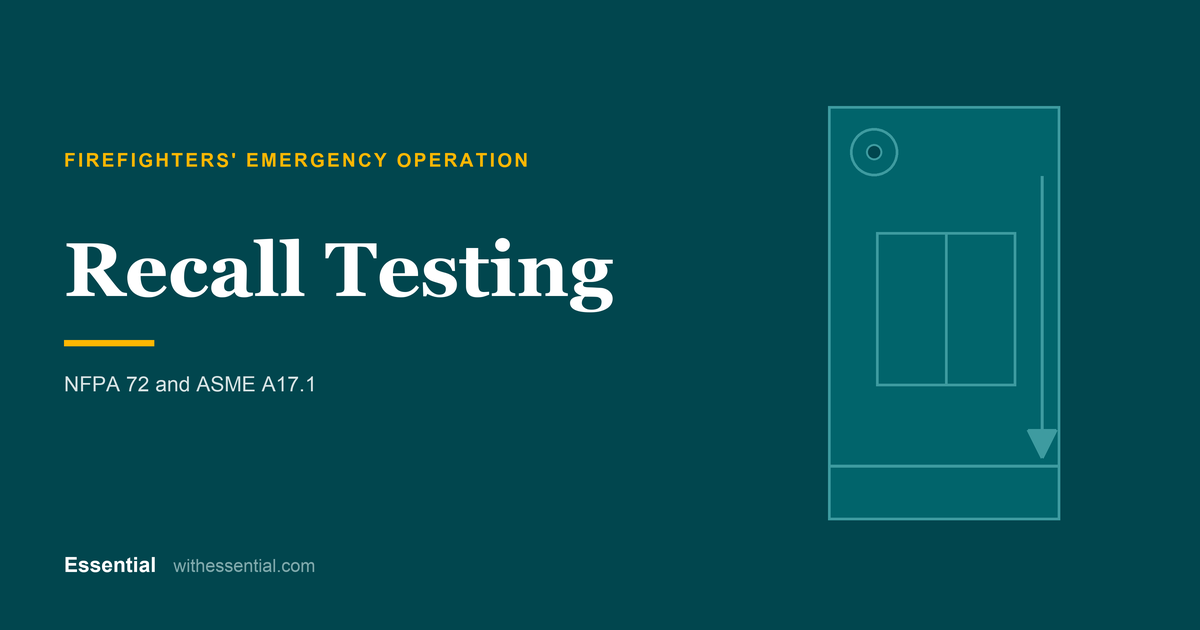
Elevator recall, formally Firefighters' Emergency Operation or FEO, automatically returns elevators to a safe landing when smoke is detected. Occupants don't get delivered onto a fire floor, and firefighters get controlled use of the car.
It's a life safety function shared by two trades. That's exactly where the deficiencies show up.
Phase I and Phase II
Phase I, automatic recall. When an initiating device operates, elevators return non-stop to the designated level, park with doors open, and stay there. If the designated-level detector operates, cars recall to the alternate level instead.
Phase II, in-car operation. Firefighters take manual control with the in-car key switch. They choose the floor and operate the doors.
The fire hat indicator shows occupants and responders that emergency operation is active.
Recall is where the fire alarm record and the elevator record have to agree, and usually they live in two systems that don't talk. Essential keeps both on the same property record. 30-minute demo.
Which devices trigger recall
Dedicated smoke detection normally initiates recall. Common locations include:
- Each elevator lobby
- The elevator machine room or machinery space
- The hoistway, where sprinklers are installed
Where sprinklers are present in the machine room or hoistway, a shunt trip arrangement removes power to the elevator before sprinkler discharge. Verifying the shunt trip and its supervision is part of testing, and a frequent finding when the two trades never coordinate.
Where NFPA 72 ends and A17.1 begins
The fire alarm relay is the handoff between trades.
- NFPA 72 covers the fire alarm system, including initiating devices and their installation. It sets inspection and testing intervals. The fire alarm contractor proves the detector operates and the relay changes state.
- ASME A17.1 covers the elevator response. The elevator contractor verifies correct recall and parking, along with Phase II operation.
Completing both contractors' scopes doesn't prove recall was tested from detector to car. An inspector may ask for documentation of that test.
Consider a 14-story office tower. In April, the fire alarm contractor runs the annual, operates every lobby detector, watches the relay change state, and signs the report. The elevator contractor logged a satisfactory monthly Phase I and Phase II check in March. Neither record shows anyone operating the designated-level detector to confirm the cars go to the alternate level. The state inspector asks for that proof in June.
The cars recall correctly. The proof doesn't exist.
How recall testing is typically performed
- Notify the monitoring company and building management, and coordinate a window with the elevator contractor.
- Operate the designated-level detector; confirm cars recall to the alternate level.
- Reset, then operate a non-designated-level detector; confirm cars recall to the designated level, park, and open doors.
- Confirm the fire hat indicator illuminates or flashes as intended.
- Verify Phase II key operation, including door control from inside the car.
- Where applicable, verify machine room and hoistway detection, and shunt trip operation with its supervision.
- Restore the system and confirm normal operation. Document every step.
How often
The fire alarm initiating devices follow their NFPA 72 inspection and testing intervals. The elevator side commonly requires a monthly operational check of Phase I and Phase II, with fuller verification at the periodic inspection.
Coordinate the fire alarm and elevator testing dates with both contractors.
Common deficiencies
- Recall tested by one trade but never documented against the other's records
- Alternate-level recall unverified after testing only the designated level
- Fire hat indicator inoperative
- Shunt trip not supervised, or never tested
- Detector replaced during service without re-verifying recall
- Phase II key missing from the building
Frequently asked questions
Who is responsible for making sure recall is tested?
The building owner carries the obligation. In practice the work splits between the fire alarm and elevator contractors, which is why written coordination matters between them.
Do elevator lobby smoke detectors have to be on the building fire alarm system?
Where a building fire alarm system exists, recall initiating devices are generally connected to and monitored by it. Check your adopted code edition.
Does a fire alarm inspection cover recall?
It covers the initiating devices and the interface. Proving the elevator itself responds correctly is a separate check, verified under the elevator code.
Keeping fire alarm and elevator records in one place
Essential's fire alarm inspection software and elevator service software keep recall test results on one property record, including the initiating detectors and the elevator response.