

That stack of spreadsheets your office manager keeps open all day? The one tracking inspection due dates, customer contacts, technician schedules, and deficiency follow-ups across six different tabs? Each one of those tabs is quietly costing your fire protection business real money. Not someday. Right now.
If you're running your fire protection company on Excel or Google Sheets, you're not alone. Plenty of contractors started the same way. A simple spreadsheet for tracking annual inspections. Another one for quotes. Maybe a shared Google Sheet the dispatcher uses to assign jobs. It works fine when you have three technicians and 200 customers. But at some point, and most owners know exactly when that point hit, the spreadsheet stops working for you and starts working against you.
Where Spreadsheet-Based Fire Protection Businesses Lose Money
The costs of running on spreadsheets don't show up on a single line item. They're spread across your entire operation, hiding in places you don't think to look.
Consider data entry alone. Industry research consistently shows that manual data entry carries an error rate of about 1% under normal conditions, and that rate climbs to 4% without a verification step. That might not sound like much. But if your office staff is keying in 1,000 inspection data points a month (device counts, deficiency notes, pass/fail results, next-due dates), you're looking at 10 to 40 errors every single month. Some of those errors are harmless. Others mean a building's annual sprinkler inspection gets scheduled for the wrong quarter, or a deficiency quote never goes out.
Each error that makes it downstream costs somewhere between $50 and $150 to fix, depending on when it gets caught. That's based on the "1-10-100" principle that's been a staple of operations management for decades: it costs $1 to prevent an error, $10 to catch it in process, and $100 or more once it reaches your customer or triggers a compliance issue. For a fire protection company, an error that reaches the AHJ is a lot more expensive than $100.
Missed Inspections and the Compliance Risk You Can't See
Here's a scenario that plays out more often than anyone wants to admit. Your office manager tracks 500 customer inspection due dates in a color-coded Excel file. She filters by month to see what's coming up. One quarter, a filter gets applied wrong, or someone sorts a column and forgets to expand the selection. Twelve buildings' annual fire alarm inspections go 60 days overdue. The AHJ contacts the building owners. Three of them call a different contractor. That's $15,000 or more in recurring annual revenue, gone because of a sorting error.
It's not a hypothetical. Roger Lu, the owner of SAFCO (a fire protection company), put it this way: his team used an Excel spreadsheet to track inspections and a whiteboard for technician schedules. As the business got busier, mistakes increased and the manual tracking couldn't keep up.
NFPA 25, NFPA 72, and NFPA 80 all require documented proof of inspection, testing, and maintenance at specific intervals. When your records live in spreadsheets that can be accidentally overwritten, deleted, or simply lost during a staff transition, you're exposed. Multiple AHJ sources consistently cite missing or incomplete inspection records as one of the top fire code violations they encounter. A spreadsheet with no version control and no audit trail is a liability waiting to surface during a records request.
The Billing Gap Nobody Catches Until Quarter-End
Your technicians complete work in the field. They fill out paper forms or text the office with job details. Someone on your team re-enters that information into a tracking spreadsheet, then creates an invoice in QuickBooks or whatever accounting tool you use. During busy season, that stack of completed work orders piles up. Some sit for weeks before they get invoiced. Some never get invoiced at all.
This is not a small problem. One fire protection company owner described getting two to three months behind on service billing, and when they finally caught up, they realized they hadn't captured everything that could have been billed. A verified review from another contractor on Capterra described the same pattern: falling months behind on invoicing and client paperwork.
Think about your own shop. If you have 15 technicians completing an average of 4 jobs per day, that's 60 completed jobs daily. If even 5% slip through the cracks over a quarter, you're looking at roughly 225 unbilled jobs. At an average ticket of $250, that's over $56,000 in revenue you earned but never collected. The work was done. The technician showed up, completed the inspection or service call, and moved on. Your company just never got paid for it.
Slow Quotes Kill More Deals Than Bad Pricing
A property manager calls three fire protection contractors after their annual inspection turns up deficiencies on a wet pipe sprinkler system. The first company has software that generates a quote directly from the inspection findings and emails it within two hours. Your company opens a spreadsheet template, manually types the scope of work, looks up pricing in another spreadsheet, formats a PDF, and sends it four days later. Your quote was $2,000 cheaper. You still lost the job.
Research on lead response times (originally published by Harvard Business Review and MIT) found that responding within five minutes produces a dramatically higher chance of winning the work compared to waiting even 30 minutes. And the data shows that most customers simply go with the first company to respond. In fire protection, where deficiency repairs are time-sensitive and building owners want the problem handled quickly, speed matters more than most contractors realize.
Every hour your quote sits in a spreadsheet template being manually assembled is an hour your competitor's automated system already delivered a professional proposal. Over the course of a year, slow quoting doesn't just cost you individual deals. It builds a reputation. Property managers learn which contractors respond fast and which ones don't.
The Growth Ceiling at 10 Technicians
There's a pattern that plays out in fire protection companies across the country. The business grows to about 8 to 12 technicians and $1 million to $2 million in revenue, and then it stalls. The owner wants to add another truck, but the office is already underwater.
The single office manager who runs the master scheduling spreadsheet, re-keys inspection data, creates invoices, handles customer calls, and tracks deficiencies is maxed out. Adding another technician means more data entry, more scheduling complexity, and more invoices to process. The owner faces a choice: hire a second admin at $50,000 or more per year, or invest in fire protection business software that automates the bulk of that administrative work.
One contractor on Capterra described the problem perfectly: they were using separate programs for response tracking, time tracking, scheduling, inspections, and pre-plans. Five different systems, none of them talking to each other, all requiring manual data transfer between them. That's the spreadsheet trap at scale. You keep adding tools and workarounds instead of replacing the foundation.
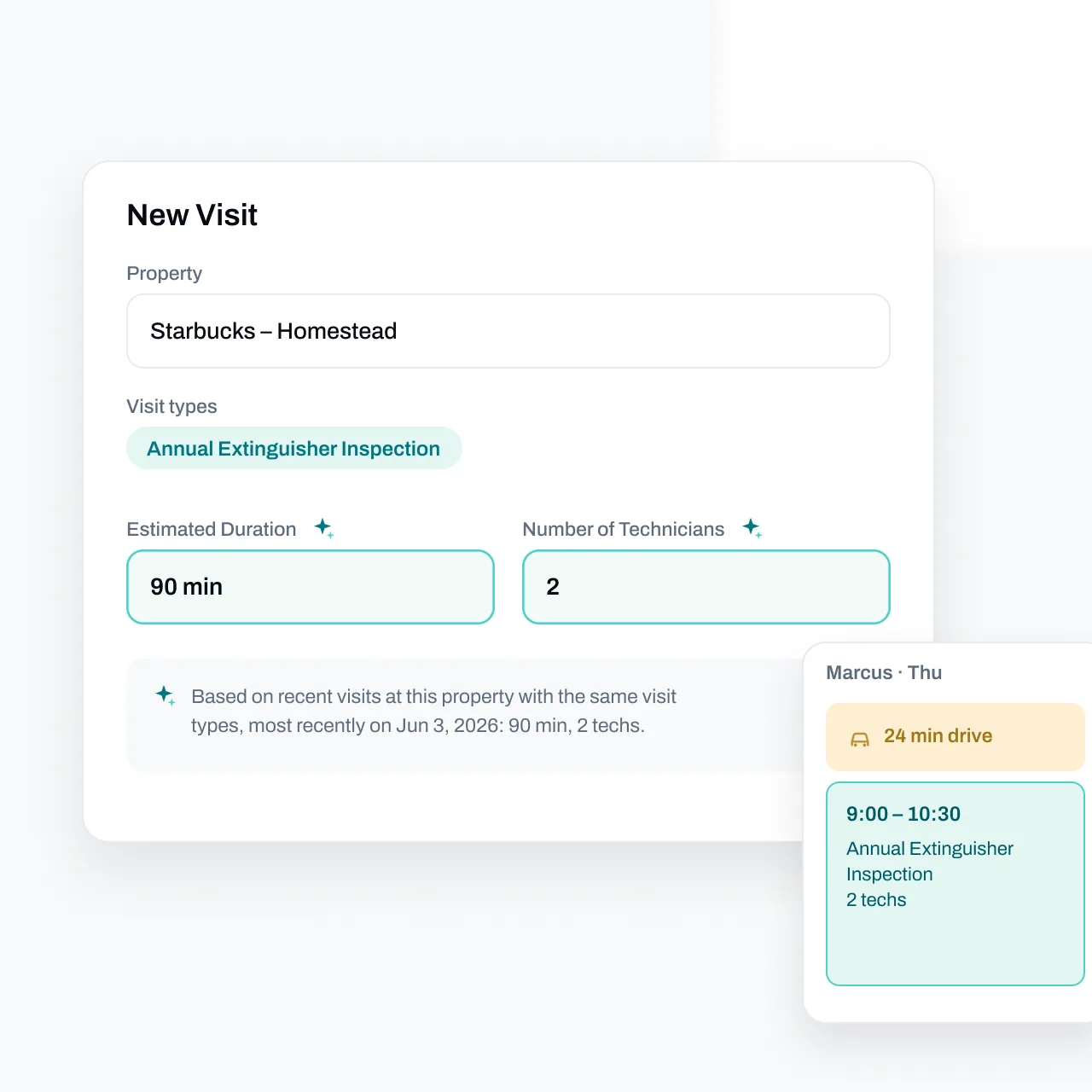
Platforms built specifically for fire protection, like Essential, include NFPA inspection templates, automated due date tracking, and quoting tools that connect directly to inspection findings. The goal isn't to add another tool on top of your spreadsheets. It's to replace the spreadsheets entirely so your office staff can focus on growing the business instead of just keeping up with it.
What This Actually Looks Like in Dollars
Pull up your own numbers and run this exercise. Take your technician count, multiply by their hourly billing rate, and calculate the gap between your current utilization rate and what you'd hit if you eliminated the paperwork bottleneck. Industry benchmarks put average field service technician utilization at 55 to 60%. Top-performing teams using proper software hit 80 to 90%. For a 10-technician company billing at $75 per hour, closing even half that gap translates to hundreds of thousands of dollars in recoverable revenue per year.
Then add the billing leakage. The lost quotes. The compliance exposure. The cost of that second admin hire you're putting off. Spreadsheets don't have a line item in your P&L, but their cost is embedded in every part of your operation.
The fire protection industry is growing. Market projections put the US fire protection systems market on track to nearly double over the next decade. The contractors who capture that growth won't be the ones still copy-pasting inspection data between tabs at 9 PM on a Friday night. They'll be the ones who built their operations on systems designed for the work they actually do.
If you're starting to feel like your spreadsheets are holding you back more than helping you, book a demo with the Essential team and see what the switch actually looks like for a company your size. It's free, and there's no commitment involved.