

You missed your kid's baseball game last Thursday. Not because you forgot, but because a customer called at 4:30 PM about a trouble signal on their FACP, your dispatcher had already left for the day, and you were the only person who knew the building's panel history. So you drove across town, handled it yourself, and got home after dark. Again.
If that sounds familiar, you're not alone. According to SCORE, 84% of small business owners work more than 40 hours a week, and 61% take fewer than five vacation days per year. For fire protection contractors specifically, the grind is even worse. You're not just running a business. You're the dispatcher, the senior tech, the estimator, the compliance tracker, and the person who remembers that Building 14 on Oak Street has a dry pipe system with a quarterly inspection due next month. If you don't systemize your fire protection business, you don't really own a company. You own a job.
That level of involvement isn't dedication. It's a trap. The fire protection industry is booming, with the U.S. market growing at roughly 7% annually. But growth means nothing if your business can't function without you standing in the middle of it. And if you want to grow your fire protection business past the ceiling you've been bumping against, you need to build systems that work whether you're in the office or on a beach.
Why Owner-Dependent Fire Protection Companies Hit a Ceiling
There's a concept from Michael Gerber's The E-Myth Contractor that hits hard for most fire protection owners. He talks about three roles inside every contractor: the Technician (you can pull a fire pump test blindfolded), the Manager (you keep the schedule and compliance calendar running), and the Entrepreneur (you build something bigger than yourself). Most of us started these businesses because we were great technicians. And we stay stuck in technician mode because nobody else can do what we do.
That's the problem. A Nationwide survey found that 71% of small businesses depend on just one or two key people for their success. When you're the key person in a fire protection company, everything flows through you. Which buildings are due for NFPA 25 quarterly inspections? You know. Which customer has that tricky pre-action system that only you've worked on? You know. Where's the quote for the 12 open deficiencies at the hospital campus? Somewhere in your head.
This is more than exhausting. It's destroying your company's value. Business valuation firms routinely apply "key person discounts" of 5% to 30% when an owner is too embedded in daily operations. For service businesses where the owner IS the business, that discount can approach 100%, meaning the company has almost no transferable value beyond the owner's personal relationships. A study of over 30,000 businesses found that companies with documented systems and reduced owner dependency sell at a 71% premium compared to average businesses.
Whether you plan to sell someday or just want to take a two-week vacation without your phone blowing up, the math is clear. You need to systemize your fire protection business so it can operate without you at the center of every decision.
The Seven Systems Every Fire Protection Business Needs
The good news about fire protection? NFPA codes already define what needs to happen and when. The "what" and "when" are written for you. Your job is building the systems to execute reliably. Here are the seven areas where you need documented, repeatable processes.
Scheduling and Dispatch
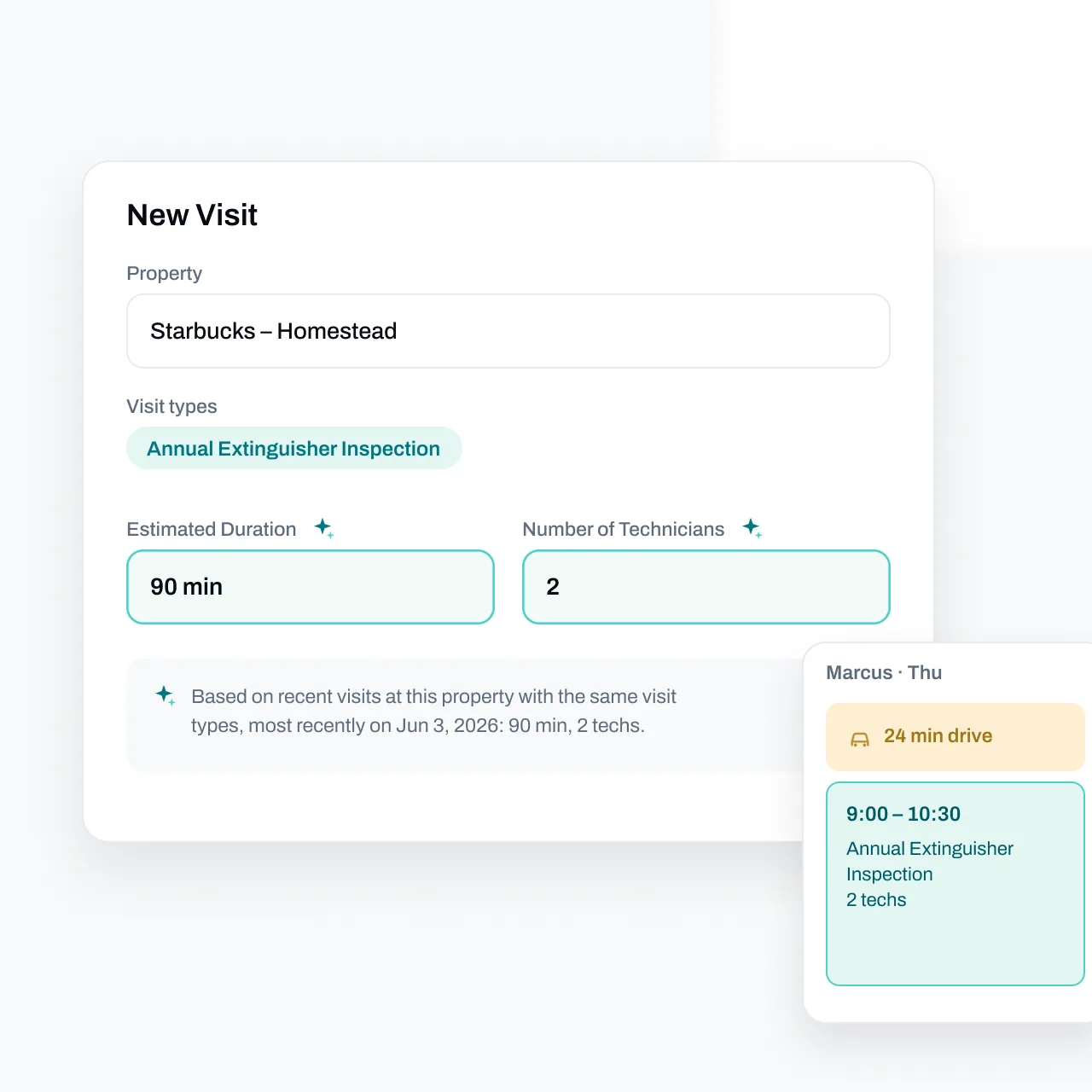
Recurring inspection scheduling based on NFPA-mandated frequencies is the backbone of your business. Your system should automatically track which buildings are due, assign techs based on certifications and location, and integrate emergency calls without blowing up the planned schedule. If your scheduling process lives in one person's head (or worse, a whiteboard), you're one sick day away from missed inspections.
Inspection Operations
Think about what happens when you send a new tech to a building for the first time. Do they know exactly which NFPA forms to use? Do they have the asset list pre-loaded? Can they work offline if the building has poor cell service? Digital inspection forms aligned to specific codes (NFPA 10, 25, 72, 80, 96) with guided question sets remove the guesswork. Photo documentation and barcode scanning create consistency regardless of who's in the field.
Deficiency Management
This is where most fire protection companies leave money on the table. Industry data suggests that fire protection businesses can generate up to $4 in service revenue for every $1 in inspection revenue. But only if deficiencies get documented, quoted, and followed up on systematically.
Say your tech inspects a 20-location restaurant chain and finds corroded sprinkler heads at four locations, a missing escutcheon plate at another, and two kitchen hood systems with expired fusible links. That's seven separate deficiency quotes that need to go out. If your process depends on a tech writing something on a paper form, handing it to the office, and someone eventually typing up a proposal, half of those quotes will never get sent. The ones that do get sent will take two weeks. By then, the customer's already called someone else. Systematic deficiency tracking with automated quote generation changes that entirely.
Quoting and Sales
A customer calls about a quote for replacing 150 extinguishers across three buildings. How long does it take your team to turn that around? If the answer is "a few days" or "whenever I get to it," you have a quoting problem. Your quoting system should let anyone on your team generate accurate, professional proposals quickly, with pricing rules and compliance frequencies already baked in.
Invoicing and Collections
Auto-generating invoices from completed work orders, recurring billing for service agreements, and automated payment reminders should be standard. If your office manager is manually creating invoices from handwritten field notes, that's hours of labor per week that could disappear with the right process.
Compliance Tracking
Here's where the stakes get real. A single commercial customer might have extinguishers (NFPA 10), sprinklers (NFPA 25), fire alarms (NFPA 72), fire doors (NFPA 80), and kitchen hoods (NFPA 96), each with different inspection frequencies across weekly, monthly, quarterly, semi-annual, annual, and multi-year cycles. Multiply that across dozens or hundreds of customers. No human memory can track it all reliably.
Miss an inspection, and you're looking at AHJ violations ($500 to $5,000+ per incident depending on jurisdiction), potential liability if a fire occurs, voided property insurance for your customer, and a damaged reputation that costs you the account. Automated inspection due date tracking with dynamic recalculation isn't a luxury. It's risk management.
Customer Communication
Automated report delivery, pre-inspection scheduling confirmations, post-inspection follow-ups, and annual service agreement renewal reminders. Your CRM should handle the routine touchpoints so your team can focus on the conversations that actually need a human.
Ready to see what systematized fire protection operations actually look like? Book a free demo with Essential and see how purpose-built fire protection software handles scheduling, inspections, deficiency tracking, and quoting in one connected platform. No commitment, no pressure.
Building Your Team So You Can Step Back
Systems without people to run them are just documentation collecting dust. The delegation path for most fire protection companies follows a predictable sequence.
Your first key hire is usually an office admin who handles invoicing, scheduling coordination, and customer calls. Next comes a lead technician who can do field quality control and mentor newer techs. Third, a dedicated dispatcher or service coordinator who owns the daily schedule. Fourth, and this is the big one, an operations manager who runs daily operations entirely. That single hire is the difference between "owner who works in the business" and "owner who works on the business."
The fifth hire is a sales or account manager who separates growth from operations.
Consider what happened to Linda Norred at Norred Fire Systems. She joined the family business planning to learn the office work so she could cover for staff when they were out sick or on vacation. Within three months, both office employees left the company, and she was suddenly running everything. That's not an unusual story in fire protection. If the only person who knows the billing process or the inspection schedule walks out the door, you're scrambling. Documented SOPs are insurance against exactly that scenario.
You don't need all five hires tomorrow. But you do need a plan for getting there, and you need documented processes so each person can actually do their job without calling you for answers.
And there's an added urgency you can't ignore. The NFPA's 2025 Industry Trends Survey found that 50% of skilled tradespeople cite the shortage of qualified candidates as their top challenge. Five experienced tradespeople retire for every two new workers entering the field. That means the labor market is only getting tighter. If you can't retain techs because your operation is chaotic and disorganized, or if you can't onboard new hires quickly because nothing is documented, you'll fall further behind. Companies with structured onboarding and documented processes reduce new hire time-to-productivity by roughly 50%.
One thing to keep in mind: "fire protection SOPs" in a Google search will mostly return firefighter department procedures. What you need are operational SOPs for your fire protection company. Things like: how do we onboard a new customer? What's the process when a tech finds a critical deficiency? How do we handle a callback? What happens when a customer disputes an invoice? Write these down. Even if the process isn't perfect yet, getting it documented means someone other than you can execute it.
The Real Payoff of Systemizing Your Fire Protection Business
Norred Fire Systems, a family business, went from paper inspection forms and handwritten invoices to digital systems. The result? 150% business growth. AAA Fire Protection in Seattle replaced paper processes and saw quote volume jump at least 50% while their pipefitting department more than doubled. Victory Fire Protection in Pottstown, PA implemented structured processes, functional leaders, and performance metrics. They projected an incremental $1.61 million in operating profit over three years.
Those aren't outliers. They're what happens when fire protection companies stop running on one person's memory and start running on systems.
The fire protection market in the U.S. is growing at roughly 7% annually. Platforms built specifically for fire protection, like Essential, include NFPA templates, offline mobile capability, and automated compliance tracking out of the box, so you don't have to build these systems from scratch. The consolidation wave (Impact Fire, Marmic, CertaSite) is paying premium valuations for systematized, owner-independent businesses. Whether you want to sell, scale, or simply stop being the person who gets the 3 AM call, the path is the same.
Build the systems. Train the people. Trust the process.
And maybe, finally, make it to the next baseball game.
If you're ready to stop being the bottleneck in your own business, book a demo with Essential to see how fire protection software built by people who understand the industry can help you get there.